
Upper Arm vs. Wrist Blood Pressure Monitors: Which Better Fits Your Home Needs?
Upper Arm vs. Wrist Blood Pressure Monitors: Which Better Fits Your Home Needs?
For households building a self-monitoring routine, the choice between an upper arm digital blood pressure monitor and a wrist digital blood pressure monitor usually comes down to cuff fit, measurement position, and the habits of the person using it. In the GENIAL home-health device range, every digital blood pressure monitor model described below uses a measurement range of 0–290 mmHg. The clear functional difference is where the cuff is placed: upper arm models wrap the brachial area, while wrist models wrap the wrist area.
A practical answer for most home users is this: if the device will live on a bedside table or in the living room and readings will be taken at roughly the same time every day, an upper arm blood pressure monitor is usually the more consistent option, especially when the cuff is matched to the user's measured arm circumference. If the priority is portability, one-handed storage, travel, or a quick spot check in different locations, a wrist blood pressure monitor is easier to carry and to put on. Both formats can be useful in the same household.
Why the Choice Between Upper Arm and Wrist Matters at Home
Blood pressure measurement is technique-sensitive. Readings are more meaningful when they are taken under consistent conditions: the user is seated and relaxed, the arm or wrist is supported, and the cuff is at approximately heart level. Because the cuff position changes with the design of the monitor, the user must be comfortable with the required posture and with the cuff itself. A cuff that is too tight, too loose, or not suited to the measurement site reduces the value of the reading even if the electronics are accurate.
Fit accuracy is therefore not a cosmetic issue. For upper arm monitors, the relevant dimension is upper arm circumference. In the GENIAL family, some models fit a 22–32 cm arm, while others support 22–42 cm. For wrist monitors, the relevant dimension is wrist circumference; GENIAL wrist models support approximately 13.5–19.5 cm or 13.5–21.5 cm depending on model. Selecting the format that matches the user's body type and daily routine helps avoid the most common home measurement errors.
Home Blood Pressure Monitoring: A Category That Keeps Growing
The pressure monitoring category has expanded well beyond clinical use. Industry research published by Grand View Research values the global blood pressure monitoring devices market at about USD 4.2 billion in 2025, with an estimate of USD 8.6 billion by 2033 and a CAGR of 9.3%. Within this category, digital blood pressure monitors are the everyday format most households recognize, and they are offered in two dominant physical styles: upper arm and wrist.
Guangdong Genial Technology Co., Ltd., operating under the GENIAL brand, has manufactured home medical health devices since 2001. The company's product scope includes digital thermometers, upper arm and wrist blood pressure monitors, pulse oximeters, mesh nebulizers, and other home-care devices. For procurement teams and distributors, the upper-arm-versus-wrist decision affects product range planning, customer satisfaction, and after-sales fit complaints, which is why published specifications matter as much as brand promise.
Upper Arm Digital Blood Pressure Monitors: Where They Excel
Upper arm monitors place the cuff around the bicep, close to the conventional brachial measurement site used in clinical-style automated readings. In the GENIAL portfolio, representative upper arm models include the GT-732, GT-732M, GT-702BM, GT-712B/C/E, GT-702V, and GT-702VA. All of them list a pressure measurement range of 0–290 mmHg, and all are classified as Upper Arm Digital Blood Pressure Monitors.
| Upper Arm Model | Arm Circumference | Pressure Range | Weight | Notable Design Point |
|---|---|---|---|---|
| GT-732 | 22–32 cm | 0–290 mmHg | 291 g ± 15 g (without battery) | Nylon binding strap; PVC air bag |
| GT-732M | 22–42 cm | 0–290 mmHg | 239 g ± 15 g (without battery) | Eco-friendly TPU air bag; pulse error ≤ ±5% |
| GT-702BM | 22–42 cm | 0–290 mmHg | 220 g ± 15 g (without battery) | Composite fabric cuff; 99 memory sets for 2 users |
| GT-712B/C/E | 22–32 cm | 0–290 mmHg | 192 g ± 15 g (without battery) | Compact ABS housing |
| GT-702V | 22–42 cm | 0–290 mmHg | 180 g ± 15 g (without battery) | Lightweight upper arm design; 99 memory sets for 2 users |
| GT-702VA | 22–42 cm | 0–290 mmHg | 155 g ± 15 g (without battery) | Modified ABS material; lightest upper arm example here |
The specification shared by these upper arm units is simple to read: if the user's measured upper arm circumference is 22–32 cm, the GT-732 and GT-712B/C/E tiers are a reasonable fit; if the arm circumference reaches beyond 32 cm up to 42 cm, the GT-732M, GT-702BM, GT-702V, and GT-702VA are the models with the larger cuff range. This distinction is one of the strongest arguments for checking real arm circumference before buying rather than assuming that one cuff size covers every adult.
Some buyers also ask about data handling for two users. The GT-702BM and GT-702V both provide 99 memory sets for 2 users, which suits a two-person household that wants to keep readings separate without manual logs. In the broader GENIAL upper arm range, the GT-702MA adds a WHO blood pressure classification display, which is why the applicable industries listed for it include physical examination centers and elderly care institutions.
Wrist Digital Blood Pressure Monitors: Strengths and Trade-Offs
Wrist monitors are the most compact category of digital blood pressure monitor. In the GENIAL range, representative wrist models are the GT-701F, GT-701L, GT-701C, and GT-701. All four use the same 0–290 mmHg measurement range as the upper arm units, but their cuff area is much smaller and their total weight is noticeably lower.
| Wrist Model | Wrist Circumference | Pressure Range | Weight | Design Point |
|---|---|---|---|---|
| GT-701F | 13.5–19.5 cm | 0–290 mmHg | 120 g ± 15 g (without battery) | Elastic knitted wrist band; pulse 30–250 bpm |
| GT-701L | 13.5–19.5 cm | 0–290 mmHg | 120 g ± 15 g (without battery) | Streamlined ABS wrist unit |
| GT-701C | 13.5–21.5 cm | 0–290 mmHg | 120 g ± 15 g (without battery) | Compact 70 × 72 × 27 mm body |
| GT-701 | 13.5–21.5 cm | 0–290 mmHg | 94 g ± 15 g (without battery) | 60 memory groups; lightest wrist example here |
Because the cuff is worn around the wrist rather than the bicep, these models usually require the user to hold the wrist unit carefully so the cuff stays at roughly heart level during the reading. In return, the user gets a monitor that is light, easy to store, and convenient during travel. The applicable industries recorded for the GT-701F include portable healthcare and travel, which reflect this intended role rather than a promise that wrist measurement is identical to brachial measurement under all body positions.
Upper Arm vs. Wrist: Side-by-Side Comparison Table
| Comparison Point | GENIAL Upper Arm Type | GENIAL Wrist Type |
|---|---|---|
| Measurement location | Cuff wraps the upper arm, near the brachial measurement site | Cuff wraps the wrist; body position awareness is important |
| Cuff size basis | Upper arm circumference support of 22–32 cm or 22–42 cm | Wrist circumference support of 13.5–19.5 cm or 13.5–21.5 cm |
| Pressure range example | 0–290 mmHg on models such as GT-732, GT-732M | 0–290 mmHg on models such as GT-701F, GT-701 |
| Typical weight | Approximately 155–291 g, depending on model | Approximately 94–120 g, depending on model |
| Memory feature | 99 memory sets for 2 users on GT-702BM and GT-702V | 60 memory groups on GT-701 |
| Best home role | Primary self-monitoring device for daily routine | Travel, portable use, or second device |
Within GENIAL's portfolio, the upper arm and wrist formats are complementary rather than competing. Many distributors stock both because households, pharmacies, and cross-border retail channels request different form factors for different customer profiles.
Which User Profile Fits Which Format?
Seniors and Daily Hypertension Monitoring
For an older adult who checks blood pressure every morning, the upper arm format is often the more practical primary device. The arm rests naturally on a table, the cuff is wide enough to spread pressure, and models such as the GT-702BM combine a 22–42 cm range with 99 memory sets for two users. The GT-702MA similarly targets elderly care and physical examination environments, where cuff range and health classification display are more relevant than pocket size.
Travelers, Commuters, and Spot-Check Users
Users who move frequently or who need to measure away from home generally prefer the wrist format. The GT-701F, with its elastic knitted wrist band and 120 g weight, and the GT-701, at roughly 94 g, are easy to fit into luggage. The trade-off is that the wrist should be rested and kept near heart level during the reading, as with any wrist-type device.
Users with Larger Upper Arms
Fit accuracy becomes a real issue when an adult's upper arm circumference exceeds 32 cm. In that case, the upper arm models with 22–42 cm support, such as the GT-732M, GT-702BM, GT-702V, or GT-702VA, are the appropriate family to check first. Prescribing a fixed small cuff to a larger arm will usually produce an unsatisfactory experience.
Multi-User Households
When two adults in the same home monitor their blood pressure separately, stored data separation matters. The GT-702BM and GT-702V both offer 99 memory sets for 2 users. This lets each user keep a personal reading history without carrying a separate device.
Retail and Project Procurement
GENIAL's case records show blood pressure monitors supplied to pharmacy chain systems for OTC sales at project volumes usually between 100,000 and 1,000,000 units over multi-year programs. For buyers planning a product portfolio, offering both upper arm and wrist SKUs reduces the risk of fit-related complaints and increases the chance of matching the right user with the right form factor.
A Simple Decision Workflow Before You Buy
- Measure the user's upper arm circumference and wrist circumference with a soft tape measure. Compare the result with the stated cuff support: 22–32 cm, 22–42 cm, 13.5–19.5 cm, or 13.5–21.5 cm.
- Decide where the monitor will actually be used. A fixed home station points toward upper arm; a bag or travel case points toward wrist.
- Confirm how many people will use the device. Two-user memory is available on upper arm models like the GT-702BM and GT-702V, while the wrist GT-701 stores 60 memory groups.
- Check whether the model is treated as a medical device in the target market and ask for the relevant registration or clearance documentation before large-volume purchase.
- For procurement or private-label projects, request samples to verify cuff feel, strap length, and display readability before mass production.
Regulatory and Manufacturing Checks: Evidence for Both Formats
Because blood pressure monitors are regulated medical devices in most export markets, buyers should verify that the chosen format has market access in the destination country. GENIAL's quality system is certified under ISO 13485, and its digital blood pressure monitor production also falls under documented quality-control procedures that include incoming material inspection, full-process inspection, and final inspection before shipment.
On the U.S. market, GENIAL holds FDA 510(k) clearances for both design families. The arm-type digital blood pressure monitor series is covered by clearance K231245, while the wrist-type GT-701 series is covered by clearance K231250. The company also holds a Japanese foreign manufacturer registration covering electronic upper arm blood pressure monitors, with certificate number BG10501496.
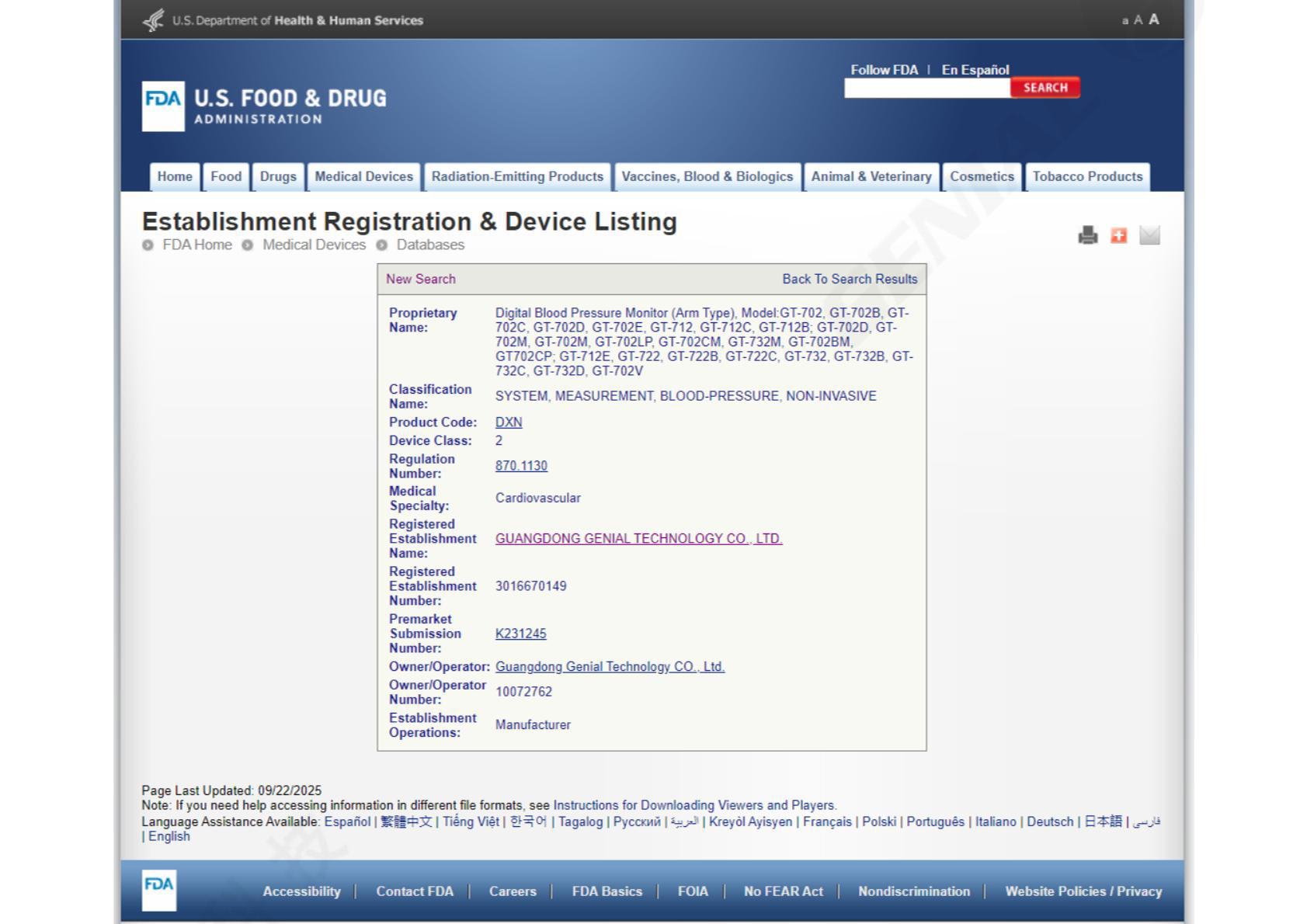
FDA 510(k) clearance K231245 covers GENIAL arm-type digital blood pressure monitors.
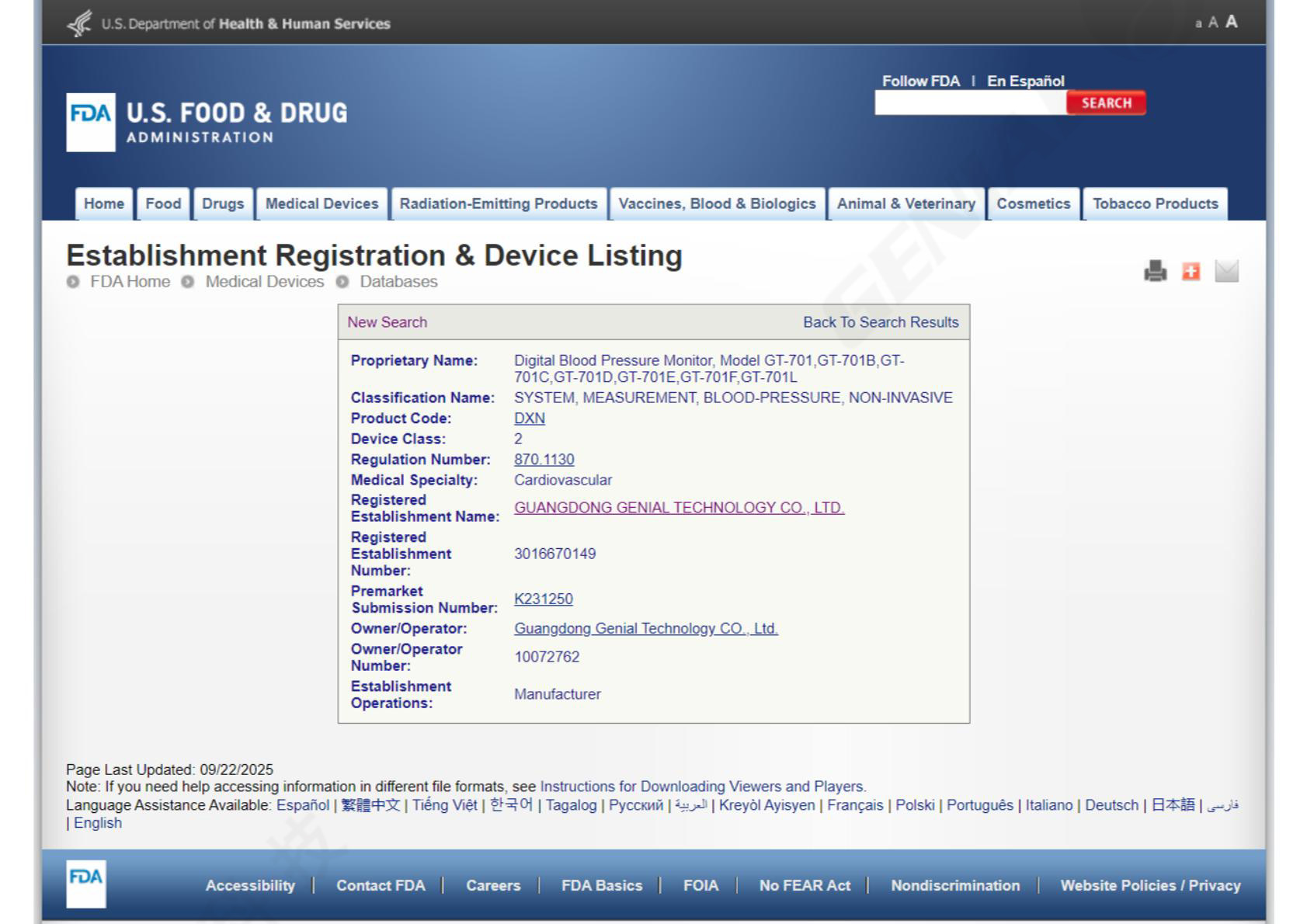
FDA 510(k) clearance K231250 covers the GENIAL wrist-type GT-701 series.
Why Manufacturing Capability Matters When You Source in Volume
For distributors, e-commerce brands, and retail importers, the upper-arm-versus-wrist decision is not only an end-user education topic; it is also an SKU-planning decision. GENIAL offers OEM, ODM, JDM, and OBM production models for home medical health devices. Under the OEM process, blood pressure monitors have a minimum order quantity of 2,000 units, while sampling is listed at about 3 days, small orders at 3–7 days, and mass orders at 10–15 days.
When a buyer needs a different housing, color scheme, logo, package, or private label, OEM customization is available for packaging, gift box, manual, logo printing, color, and packaging specifications, while core hardware and key functions remain unchanged. ODM goes further, allowing customization of industrial design, tooling, structure, PCB firmware, algorithms, display interface, and exclusive product model registration. GENIAL's total monthly production capacity across its home medical device lines is stated between 60,000 and 6,000,000 units, which gives procurement teams a practical reason to verify capacity before committing to multi-channel programs.
FAQ
Which is better for home use, an upper arm or a wrist blood pressure monitor?
For a fixed home routine, upper arm models are generally the more widely preferred format because the cuff sits closer to the conventional brachial measurement site and the arm can rest on a flat surface. GENIAL upper arm models support an arm circumference of 22–32 cm or 22–42 cm. A wrist monitor is the more portable choice, and models such as the GT-701F or GT-701 may be used when the wrist can be kept near heart level during the measurement.
Which GENIAL upper arm model fits an arm circumference above 32 cm?
The GT-732M, GT-702BM, GT-702V, and GT-702VA support an upper arm circumference of 22–42 cm. If the measured circumference is 22–32 cm, the GT-732 and GT-712B/C/E models are also suitable. Always measure the actual arm circumference and compare it with the model's cuff specification.
Are GENIAL upper arm and wrist monitors cleared for the U.S. market?
Yes. The arm-type digital blood pressure monitor series is covered by FDA 510(k) clearance K231245, and the wrist-type GT-701 series is covered by FDA 510(k) clearance K231250. GENIAL also holds Japanese foreign manufacturer registration BG10501496 covering electronic upper arm blood pressure monitors.
What is the minimum order quantity for a private-label blood pressure monitor project?
Under GENIAL's OEM production model, blood pressure monitors have a minimum order quantity of 2,000 units. For ODM projects, a product modification begins at 5,000 units, while a new mold development starts at 10,000 units. In-stock products can be evaluated through lower-volume sample requests before a mass-order commitment.
How quickly can GENIAL support sampling or ODM development?
In the OEM process, sample lead time is about 3 days, small orders 3–7 days, and mass orders 10–15 days. For ODM, minor modifications without new tooling take about 7–15 days, while new mold development takes about 45–50 days before mass production.
Conclusion
Choosing between an upper arm and wrist blood pressure monitor should start with the user's body measurement and daily measurement routine, not with the visual style of the device. Upper arm models are well suited to regular home monitoring and to users whose larger arm circumference requires a cuff range up to 42 cm. Wrist models are the sensible option when portability and light weight matter most.
GENIAL's range includes both formats with a documented 0–290 mmHg measurement range, clearly published cuff ranges, FDA clearance evidence for both families, and manufacturing programs that let a brand move from a single in-stock order to an exclusive ODM model. If you are selecting a monitor for a household, a pharmacy shelf, or a private-label program, request the current specification sheet and compare cuff ranges against your actual target users.
Need a sample or catalog? GENIAL supports OEM, ODM, JDM, and OBM projects for upper arm and wrist blood pressure monitors. The 2026 English catalog can be downloaded here. For specification or quotation questions, contact market6@genial.cn or WhatsApp +86 18938327866, or visit www.cngenial.com.
Have Questions or Need More Details?
Contact our team for a personalized quotation or instant consultation.
Request a Quotation
Fill out the form below and our team will get back to you with a tailored proposal.
WhatsApp Direct Chat
Prefer to chat in real-time? Message us on WhatsApp for instant assistance & quick answers.
- Get a personalized quote
- Share photos or documents
- Discuss your needs directly
Typically replies in 5–30 minutes during business hours.