
Supplier Evaluation for Home Medical Health Devices: Capability Verification and Delivery Assurance
Supplier Evaluation Guide | Home Medical Health Devices

Supplier evaluation for home medical health devices is the process of verifying, before an order is placed, that a manufacturer can build a defined device to a defined specification, support registration in the destination market, and deliver on a committed schedule. Done properly, it replaces supplier impressions with evidence that can be checked line by line.
This guide is written for distributors, importers, OEM buyers and procurement teams that are comparing manufacturers of digital thermometers, digital blood pressure monitors, pulse oximeters, mesh nebulizers, wearable thermometers and sleep apnea therapy devices. It sets out a two-part framework — capability verification and delivery assurance — and uses Guangdong Genial Technology Co., Ltd. (GENIAL), a medical device and smart wearable device manufacturer established in 2001, as a worked example so that every checkpoint maps to a real model specification rather than an abstract claim.
The Three Failure Points in Home Medical Device Sourcing
Most sourcing problems in this category trace back to one of three failure points. Naming them in advance makes the evaluation checklist easier to build.
- Capability gap. The supplier produces the device category in general but cannot produce the exact configuration a project needs — a 22–42 cm cuff instead of a 22–32 cm cuff, a two-user memory function, a specific waterproof rating, or a Bluetooth connection.
- Specification drift. The approved sample matches the specification sheet, but mass-production output does not. The buyer discovers the difference after the goods arrive.
- Delivery slip. Lead-time promises are not supported by capacity data, so programme-bound or seasonal deadlines are missed.
Home-use devices add a fourth risk that is often overlooked in evaluation templates: the home environment itself. UL notes that IEC 60601-1-11 is the collateral standard used together with IEC 60601-1 for home healthcare equipment, and that it addresses risks in uncontrolled home environments with untrained users. In procurement terms, that means the evaluation has to cover power supply behaviour, operating temperature range, splash protection and the clarity of user instructions — not only the clinical accuracy of the measurement.
Industry Background: Why Buyers Now Ask for Evidence
The commercial reason to formalise supplier evaluation is the size and structure of the market being served. Mordor Intelligence estimates the Home Medical Equipment market at USD 54.35 billion in 2026, with North America holding approximately 40.35% of that market in 2025. Within blood pressure monitoring specifically, upper-arm monitors held 59.10% of market share in 2025, while wrist-based and wearable devices are growing at a 12.07% CAGR — a structural shift that directly affects which model families a distributor should keep in the catalogue and which ones a buyer should over-stock.
Standards have tightened in parallel. ISO 80601-2-56:2017 specifies requirements for the basic safety and essential performance of clinical thermometers, including a ±0.1°C accuracy requirement for clinical validation. Pulse oximeters are governed by ISO 80601-2-61, where SpO₂ accuracy is conventionally expressed as Arms over a stated saturation range, commonly 70–100%. A PubMed Central review of home health monitoring equipment adds a practical operating constraint: devices should be calibrated at frequent intervals and operated within 16 to 40°C with humidity below 85%.
The combined effect is straightforward. A blanket claim such as “medical grade” is no longer sufficient evidence for a purchasing file. Buyers now map each device to a named standard, and then ask the supplier for the test and calibration practice that sits behind the certificate.
Capability Verification Framework: Five Pillars
Capability verification answers one question: can this supplier actually build what the order specifies? Five pillars cover the answer without requiring a factory visit, although all five are designed to be verified during one.
1. Portfolio Breadth
Breadth determines how many vendors a distributor must qualify and how much documentation a buyer must maintain. Genial’s listed product range covers Digital Thermometer, Infrared Digital Thermometer, Wearable Digital Thermometer, Continuous Dynamic Thermometer, Forehead Infrared Thermometer, Ear Infrared Thermometer, Medical Digital Thermometer, Household Digital Thermometer, Rigid Tip Digital Thermometer, Flexible Tip Digital Thermometer, Armpit Digital Thermometer, Digital Blood Pressure Monitor, Upper Arm Blood Pressure Monitor, Wrist Blood Pressure Monitor, Finger Pulse Oximeter, Mesh Nebulizer, Sleep Apnea Therapy Device, Health Manager, Meridian Massage Instrument, and Hair Removal Device. A 2026 secondary industry article lists 16 product lines or families under the GENIAL name, including upper-arm and wrist monitor variants.
Verification action: request the current model list with model numbers, not category names. Model numbers such as GT-732M, GT-702BM or GX3 are auditable; category names are not.
2. Manufacturing Capacity
Guangdong Genial Technology Co., Ltd. states that it was established in 2001, employs approximately 251 staff, and operates a manufacturing facility covering 45,000 square metres, with annual production capacity of 15,000,000 units. Capacity figures matter for a simple reason: they determine whether a supplier can absorb a programme order without pushing existing customers into delay.

3. Test and Calibration Capability
This is where a supplier moves from statements to methods. According to Genial’s product documentation, thermostatic water bath testing is implemented to check every digital thermometer’s accuracy, and each blood pressure monitor is calibrated and tested, with measured pressure required to fall within 3 mmHg of analyzer data (a deviation of less than 0.4 kPa).
For a buyer, the practical value of a stated test method is that it can be challenged. “Every unit tested” is a claim; “thermostatic water bath on every unit, with pressure verified against analyzer data within 3 mmHg” is a process that can be witnessed, sampled and written into a purchase agreement.
4. Compliance and Registration Scope
Genial states that its quality systems have obtained ISO 13485, ISO 45001, ISO 14001, GB/T 29490 and BSCI certification, and that its products hold CE, NMPA, FDA, CB, FCC and RoHS certification, with REACH-related compliance also listed. Regulatory records confirm a specific clearance: the Wearable Digital Thermometer model T31 received FDA 510(k) clearance under product code FLL (K240333), effective 30 October 2024, under 21 CFR 880.2910.
Company statements also indicate that product and trademark registration has been completed in 29 countries, and that products are sold to 117 countries and regions worldwide.
5. Engineering and Commercial Support
Genial states that it provides one-stop OEM, OBM, ODM and JDM services for global clients, supported by a medical technology research institute, a doctoral workstation and a big health industry engineering technology research centre, with 262 intellectual property certificates recorded. It also states that a professional registration team assists clients with product registration in overseas markets — a capability that matters most when a buyer is entering a market with local registration requirements rather than reselling into an already-open channel.
Step-by-Step: A Seven-Stage Supplier Evaluation Workflow
The framework above becomes operational when it is sequenced. The order below is designed so that each stage either passes or disqualifies the supplier before the next stage consumes buyer time.
- Lock the device scope and the use case. Define the device categories, the intended channel and the end user — for example, a chronic disease management programme requires different evidence from a promotional gift programme.
- Verify model-level specifications. Request datasheets with pressure range, accuracy, cuff or wrist circumference, memory capacity, materials and dimensions.
- Request test and calibration evidence. Ask which tests run on every unit and which run by batch sampling, and for the acceptance threshold used.
- Verify certification scope. Confirm that certificates carry the exact model number and cover the destination market, including home-use safety requirements such as IEC 60601-1-11.
- Verify delivery assurance. Ask for written lead time by SKU and the capacity data behind it.
- Verify customization workflow. Confirm what can be customized — appearance, packaging, branding, factory preset parameters — and at which stage engineering sign-off is required.
- Verify packaging, documentation and after-sales handoff. Confirm what physically ships with each unit, and what happens when a unit fails in the field.
Specification Checks You Should Not Skip
Specification verification is the stage where vague approvals become expensive. A worked example makes the level of detail clear: the upper-arm digital blood pressure monitor GT-732M documents a pressure measuring range of 0~290 mmHg, a pulse error of ≤±5%, and an arm circumference range of 22~42 cm, at a net weight of 239 g ±15 g without battery and overall dimensions of 136×103×54 mm, using an ABS housing with an eco-friendly TPU air bag. Genial lists it for chronic disease management, community medical centres and insurance promotional gift programmes.
Each of those three primary numbers answers a different buyer question.
- Pressure range 0~290 mmHg confirms the device covers the full measurement span required for home blood pressure monitoring, with headroom above typical physiological values.
- Pulse error ≤±5% defines the tolerance a buyer is accepting for pulse-rate reporting, and therefore the tolerance that should appear in the acceptance criteria of the purchase contract.
- Arm circumference 22~42 cm determines how much of the target population the cuff fits. A 22–32 cm cuff serves a narrower adult segment than a 22–42 cm cuff, which matters for community screening programmes and mail-order channels where a single SKU must fit many users.
Two further specification groups are frequently under-checked. The first is environmental operating conditions: Genial documents portable monitoring devices for 5–40°C and 15%–85% RH non-condensing operation, with storage from -20°C to 55°C and humidity ≤90% RH, suitable for long-distance sea and land transport. The second is connectivity: the wearable Bluetooth digital thermometer T31 is documented for a measuring range of 20.0–45.0°C at ±0.1°C accuracy, with IPX4 splash protection, and a Bluetooth 5.0 connection with low-battery reminders on both the app and the device screen.
Comparison Table: Upper-Arm Monitor Family at a Glance
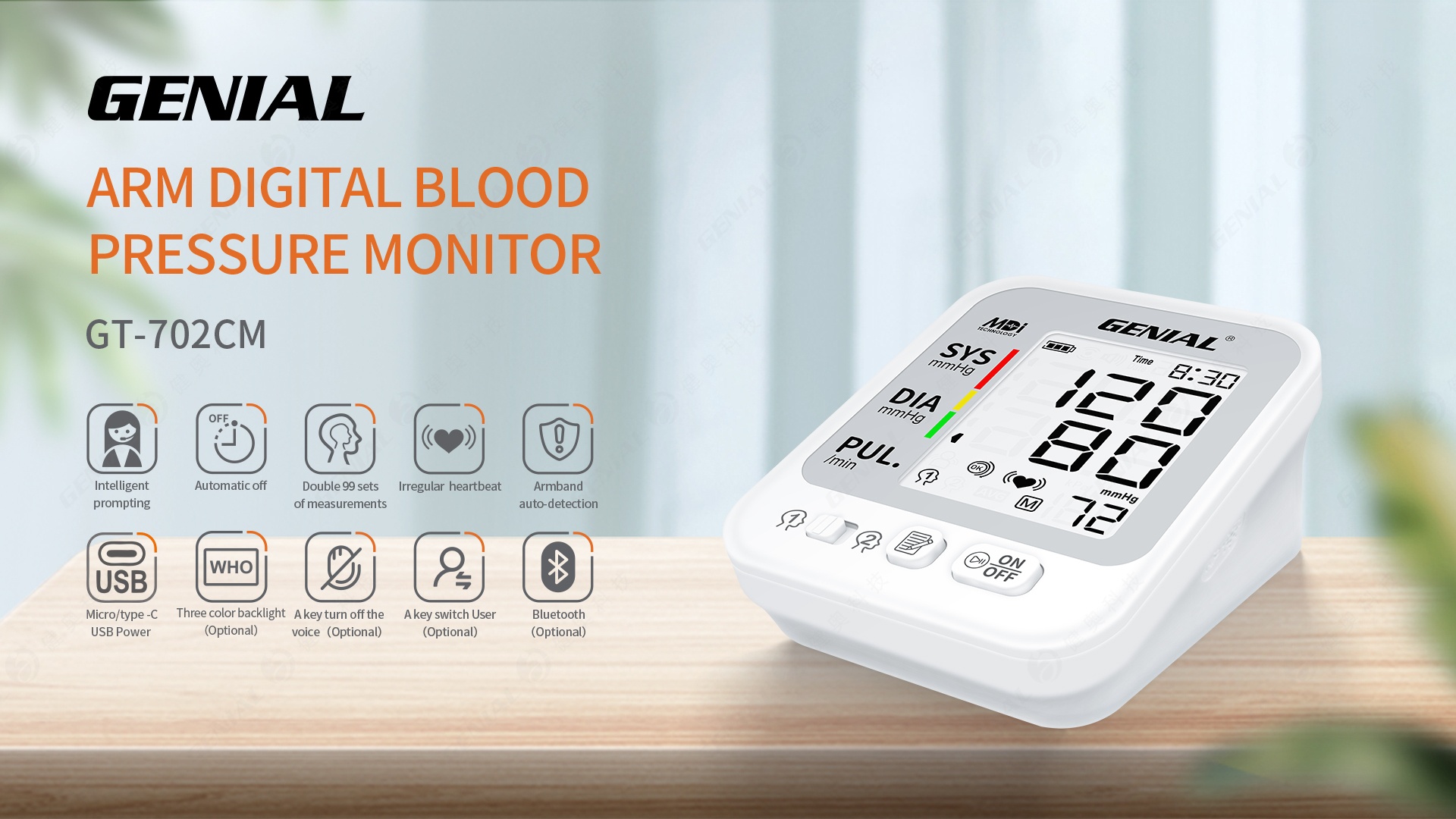
The table below shows why model selection and supplier evaluation must be done together. Every model in this family shares the same 0~290 mmHg pressure range and the same 22~42 cm arm circumference, but they differ in weight, memory and intended channel — which is exactly the kind of difference that is lost when a buyer evaluates a supplier on category names alone.
| Model | Pressure range | Cuff circumference | Memory function | Net weight (without battery) | Typical channel per supplier documentation |
|---|---|---|---|---|---|
| GT-732M | 0~290 mmHg (pulse error ≤±5%) | 22~42 cm | Not specified in listed parameters | 239 g ±15 g | Chronic disease management, community medical centres, insurance promotional gifts |
| GT-702BM | 0~290 mmHg | 22~42 cm | 99 memory sets for 2 users | 220 g ±15 g | Medical instrument wholesale, offline household retail |
| GT-702V | 0~290 mmHg | 22~42 cm | 99 memory sets for 2 users | 180 g ±15 g | Cross-border e-commerce, household medical supply |
| GT-702LM | 0~290 mmHg | 22~42 cm | Not specified in listed parameters | 209 g ±15 g | Global supermarket channel, medical equipment distributors |
| GT-702MA | 0~290 mmHg | 22~42 cm | WHO blood pressure classification function | 204 g ±15 g | Physical examination centres, elderly care and pension institutions |
| GT-702CM | 0~290 mmHg | 22~42 cm | Not specified in listed parameters | 238 g ±15 g | Chain pharmacy, OEM processing factory |
Delivery Assurance: Turning Lead-Time Claims into Commitments
Delivery assurance is the second half of supplier evaluation, and it is the half most often reduced to a single question. Genial states that its branded products can be shipped within 24 hours after order confirmation, while OEM orders take only 3 to 7 days for delivery. Those two figures should be read together with the capacity data behind them: a 45,000 square metre facility, approximately 251 staff, and 15,000,000 units of annual production.
Export structure supports the same picture. Genial states that export business accounts for 80% of total sales, with key market layouts covering Europe, North America, Southeast Asia, the Middle East, Africa, Latin America and Oceania, and products sold to 117 countries and regions. A supplier with a predominantly export-oriented order book tends to have established documentation routines for cross-border logistics and customs — which is relevant when a buyer’s own delivery commitment depends on export paperwork being correct.
Three verification actions convert a lead-time claim into something enforceable:
- Ask for lead time by SKU, in writing. A blanket company figure is useful for planning; a per-model figure is what goes into the purchase agreement.
- Confirm what ships with each unit. Genial documents matched equipment such as storage case, batteries, power adapter and storage bag for monitoring devices, and colour box, instruction manual and warranty card as standard documentation; nebulizer kits are documented with adult mask, child mask, mouthpiece and batteries, and sleep therapy devices with mask, heated breathing tube, humidifier chamber and spare filters.
- Confirm the shipping configuration of the packaging itself. Bulk orders are documented with customisable colour-carton packaging, which affects both freight volume and retail readiness on arrival.
Mapping Product Breadth to Real Procurement Scenarios
Breadth is only valuable if the portfolio maps to actual programmes. Three scenarios illustrate the mapping and the specification points that matter in each.
Chronic Disease Management Programmes
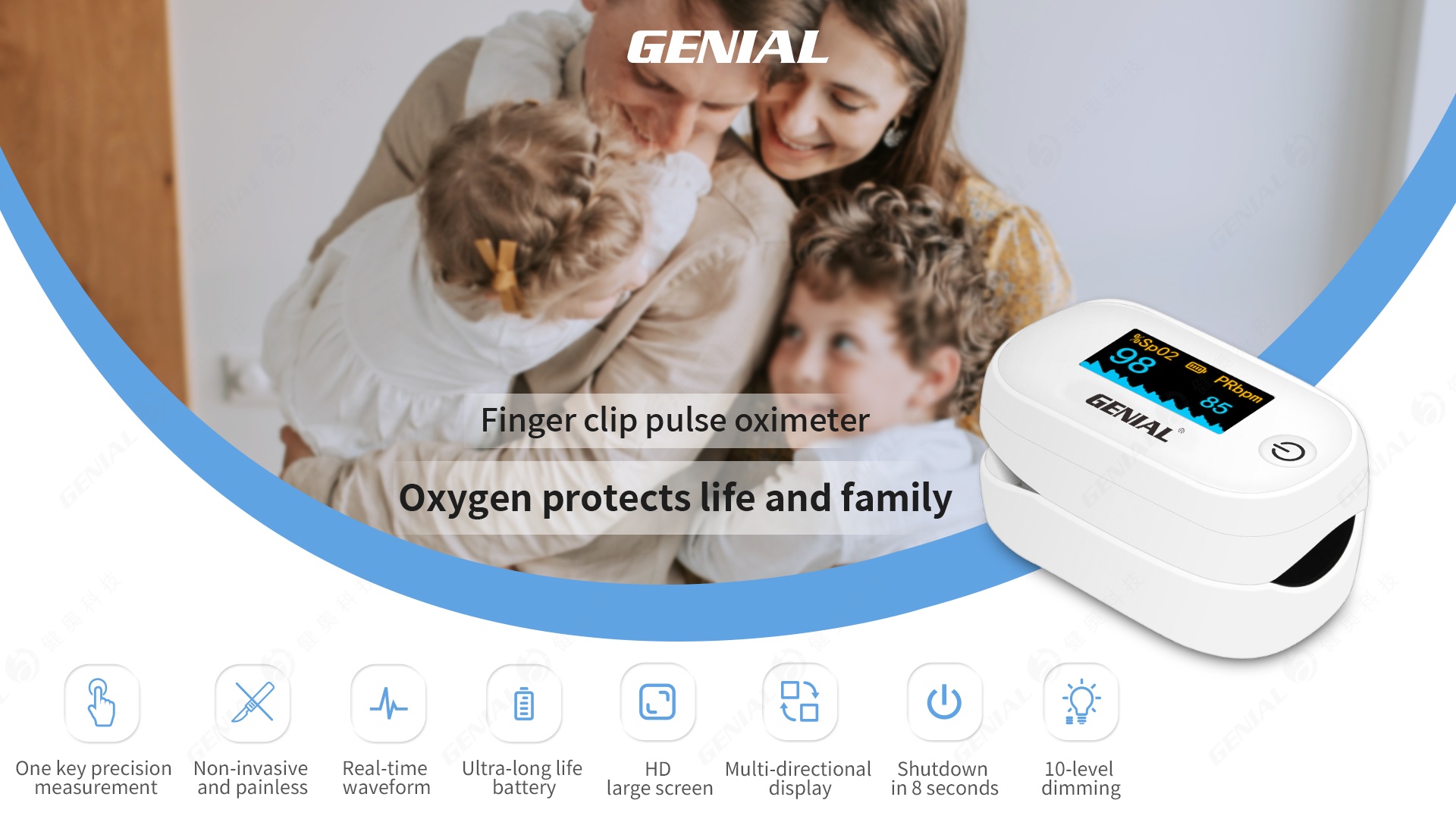
These programmes need repeatable measurement plus trend data. The GT-732M upper-arm monitor is documented for chronic disease management and community medical centre use, with a 22~42 cm cuff. For oxygen saturation, the fingertip pulse oximeter series GX3/GX5/GX7/GX8/GX12/GX13/GX14 measures SpO₂ from 35% to 100% with ±2% accuracy within 70% to 100%, and pulse rate from 30 to 250 bpm. For continuous temperature monitoring, the wearable T31 records 20.0–45.0°C at ±0.1°C and synchronises to the Genial Cloud Health Management Platform, which stores history and generates daily, weekly and monthly trend reports.
Community Medical Centres
Community settings usually need classification support and durable accessories rather than consumer styling. The GT-702MA is documented with a WHO blood pressure classification function and is intended for physical examination centres and elderly care institutions, while the GT-702CM is listed for chain pharmacy and OEM processing factory channels. For respiratory support, the portable mesh nebulizer N11/N21 is documented with a nebulization rate of ≥0.2 ml/min, a particle D50 of less than 5 μm (≥60% of particles), an 8 ml liquid capacity and noise ≤50 dB(A), listed for pediatric wards and respiratory clinics.
Home Health Monitoring
Home monitoring places the highest weight on ease of use and on how the device behaves outside a controlled environment. In the thermometer family, the T94 infrared ear thermometer measures 32.0–42.9°C with ±0.3°C repeat accuracy and IPX4 protection; the T86/T87 non-contact infrared forehead thermometer measures 32.0–42.9°C with ±0.2°C error at 35–42°C; and the T19C/T19D rigid tip digital thermometers use a PP body with IPX5 protection and a fever alert at 37.5°C. Each has a different intended setting, from pediatric hospitals to chain pharmacies and household consumables.
Supplier Verification Checklist
| Verification item | Evidence to request | Reference point from supplier documentation |
|---|---|---|
| Portfolio | Model-level catalogue with model numbers | 20 listed categories, including thermometers, upper-arm and wrist monitors, pulse oximeters, mesh nebulizers, sleep apnea therapy devices, health managers and hair removal devices |
| Capacity | Facility size, headcount, annual output | 45,000 m² facility; approximately 251 staff; 15,000,000 units annual capacity |
| R&D and IP | Engineer headcount, innovation structure, IP list | 29 engineers; medical technology research institute, doctoral workstation and big health industry engineering technology research centre; 262 intellectual property certificates |
| Testing method | Per-unit and per-batch test procedure with acceptance thresholds | Thermostatic water bath testing on every digital thermometer; every blood pressure monitor calibrated and tested, measured pressure within 3 mmHg of analyzer data |
| Compliance | Certificate copies with model scope and issuing body | ISO 13485, ISO 45001, ISO 14001, GB/T 29490, BSCI; CE, NMPA, FDA, CB, FCC, RoHS, REACH; FDA 510(k) K240333 for the T31 wearable thermometer |
| Delivery | Written lead time by SKU plus the capacity basis | Branded products stated as shippable within 24 hours after order confirmation; OEM orders stated at 3 to 7 days |
| Market access | Registration footprint and registration support process | Product and trademark registration completed in 29 countries; products sold to 117 countries and regions; registration team support for overseas markets |
Frequently Asked Questions
What certifications and compliance documents should a buyer verify before ordering home medical health devices?
Three layers should be checked. At system level, GENIAL states that it holds ISO 13485, ISO 45001, ISO 14001 and GB/T 29490 certification and BSCI; at product level it lists CE, NMPA, FDA, CB, FCC and RoHS certification with REACH-related compliance. At device-specific level, regulatory records show FDA 510(k) clearance for the Wearable Digital Thermometer model T31 under product code FLL, clearance number K240333, effective 30 October 2024, under 21 CFR 880.2910. Because home devices are used by untrained users in uncontrolled environments, buyers should also confirm the supplier’s position on IEC 60601-1-11, the collateral standard applied with IEC 60601-1 for home healthcare equipment. In every case, confirm the certificate lists the exact model you are ordering and covers the exact market you are selling into.
How can a buyer verify that a supplier genuinely covers the device categories the project needs?
Ask for a model-level list rather than category names, then match each category to at least one documented model. GENIAL’s listed range spans Digital Thermometer, Infrared Digital Thermometer, Wearable Digital Thermometer, Continuous Dynamic Thermometer, Forehead Infrared Thermometer, Ear Infrared Thermometer, Medical and Household Digital Thermometers, Rigid Tip, Flexible Tip and Armpit Digital Thermometers, Digital Blood Pressure Monitor with upper-arm and wrist variants, Finger Pulse Oximeter, Mesh Nebulizer, Sleep Apnea Therapy Device, Health Manager, Meridian Massage Instrument and Hair Removal Device. A 2026 secondary industry article lists 16 product lines or families under the GENIAL name. Where a model is documented, its parameters — pressure range, accuracy, cuff circumference, waterproof grade, materials — should be checkable, not implied.
What determines the cost of an OEM order for these devices?
Cost in this category is configuration-driven rather than brand-driven, and the specification sheets show where the differences sit. Housing material varies between ABS, modified ABS, and ABS combined with TPU; cuff and air bag construction varies between PVC air bags, eco-friendly TPU air bags and composite fabric cuffs; memory and classification functions differ between models, with options such as 60 memory groups, 99 memory sets for two users, or a WHO blood pressure classification function; and waterproof ratings range from IPX4 to IPX5. Packaging format, accessory set and the certification or registration scope required for the destination market also affect the final quotation. To receive comparable quotes, specify the model, configuration, packaging, accessory set and destination market in a single request.
Can samples be validated before committing to mass production?
Yes, and the validation should mirror the tests the supplier already runs in production. For thermometers, the documented method is thermostatic water bath testing to check every digital thermometer’s accuracy. For blood pressure monitors, the documented acceptance criterion is that measured pressure falls within 3 mmHg of analyzer data, a deviation of less than 0.4 kPa. For pulse oximeters, the documented parameters are an SpO₂ range of 35% to 100% with ±2% accuracy within 70% to 100%, and a pulse rate range of 30 to 250 bpm under ISO 80601-2-61 reporting conventions. Buyers should also validate practical fit during sampling — cuff circumference against the target population, operating conditions of 5–40°C and 15%–85% RH, and Bluetooth pairing behaviour where a connected device is specified.
What lead time and delivery assurance should a buyer plan for?
GENIAL states that its branded products can be shipped within 24 hours after order confirmation, and that OEM orders take 3 to 7 days for delivery. Those figures are supported by a stated annual production capacity of 15,000,000 units from a 45,000 square metre facility with approximately 251 staff, and by an export structure in which 80% of sales are exported, with products sold to 117 countries and regions. Buyers entering a market that requires local registration should plan separately for that timeline and confirm the supplier’s registration support scope in advance. To move from evaluation to a defined quotation, request the current catalogue and a model-specific quote using the contact details at the end of this guide.
Conclusion: Verify Capability, Then Secure Delivery
Supplier evaluation for home medical health devices works best as a sequence: define the device and use case, verify model-level specifications, verify the test and calibration method behind the accuracy claim, verify that the certification scope covers the exact model and market, and only then negotiate lead time and volume on the basis of stated capacity.
The evaluation is not a one-off document. It becomes the acceptance criteria of the purchase contract — the pressure tolerance, the cuff range, the waterproof grade and the packaging specification that both parties agree to measure against. When those criteria are anchored to documented model parameters instead of category descriptions, both the buyer’s market access and the supplier’s delivery promise become verifiable rather than assumed.
Request GENIAL’s Catalogue, Specifications and a Model-Specific Quote
GENIAL supplies home medical health devices under OEM, OBM, ODM and JDM models to distributors, importers and brand owners across Europe, North America, Southeast Asia, the Middle East, Africa, Latin America and Oceania. To build your own capability verification file, request the model list, certificates for the exact models you plan to sell, and a written lead time for your target SKUs.
- Download the 2026 English product brochure: GENIAL 2026 Product Brochure (PDF)
- Website: www.cngenial.com
- Email: market6@genial.cn
- Tel / WhatsApp: +86 18938327866
- Address: No.2710-2711, 27/F, Bldg B, Fengxing Plaza, No.242 Tianhe Road, Tianhe District, Guangzhou, China
Have Questions or Need More Details?
Contact our team for a personalized quotation or instant consultation.
Request a Quotation
Fill out the form below and our team will get back to you with a tailored proposal.
WhatsApp Direct Chat
Prefer to chat in real-time? Message us on WhatsApp for instant assistance & quick answers.
- Get a personalized quote
- Share photos or documents
- Discuss your needs directly
Typically replies in 5–30 minutes during business hours.