
Understanding Pulse Error and Pressure Accuracy: Technical Specs of Upper Arm Monitors
Understanding Pulse Error and Pressure Accuracy: Technical Specs of Upper Arm Monitors
Short answer: on an upper arm digital blood pressure monitor, the pressure measuring range describes the span the device is engineered to measure, while the pulse error limit describes how far a displayed pulse value may drift. Across GENIAL's upper arm specification set, the pressure measuring range is consistently 0~290 mmHg, and the pulse channel is limited to ≤±5% — written as “pulse tolerance ±5%” on GT-732 and “pulse error ≤±5%” on GT-732M. One figure is about coverage; the other is about tolerance. Treating them as the same number is the most common misreading of a blood pressure monitor datasheet.
This guide explains both specifications in plain language, shows what a ±5% pulse limit actually means at real heart rates, and connects those numbers to the physical build: ABS and modified ABS housings, PVC and eco-friendly TPU air bags, and nylon or composite fabric cuffs. It is written for buyers evaluating upper arm monitors for home healthcare, pharmacy, elderly care and project procurement programmes, and it closes with a model-by-model comparison drawn strictly from published specifications.
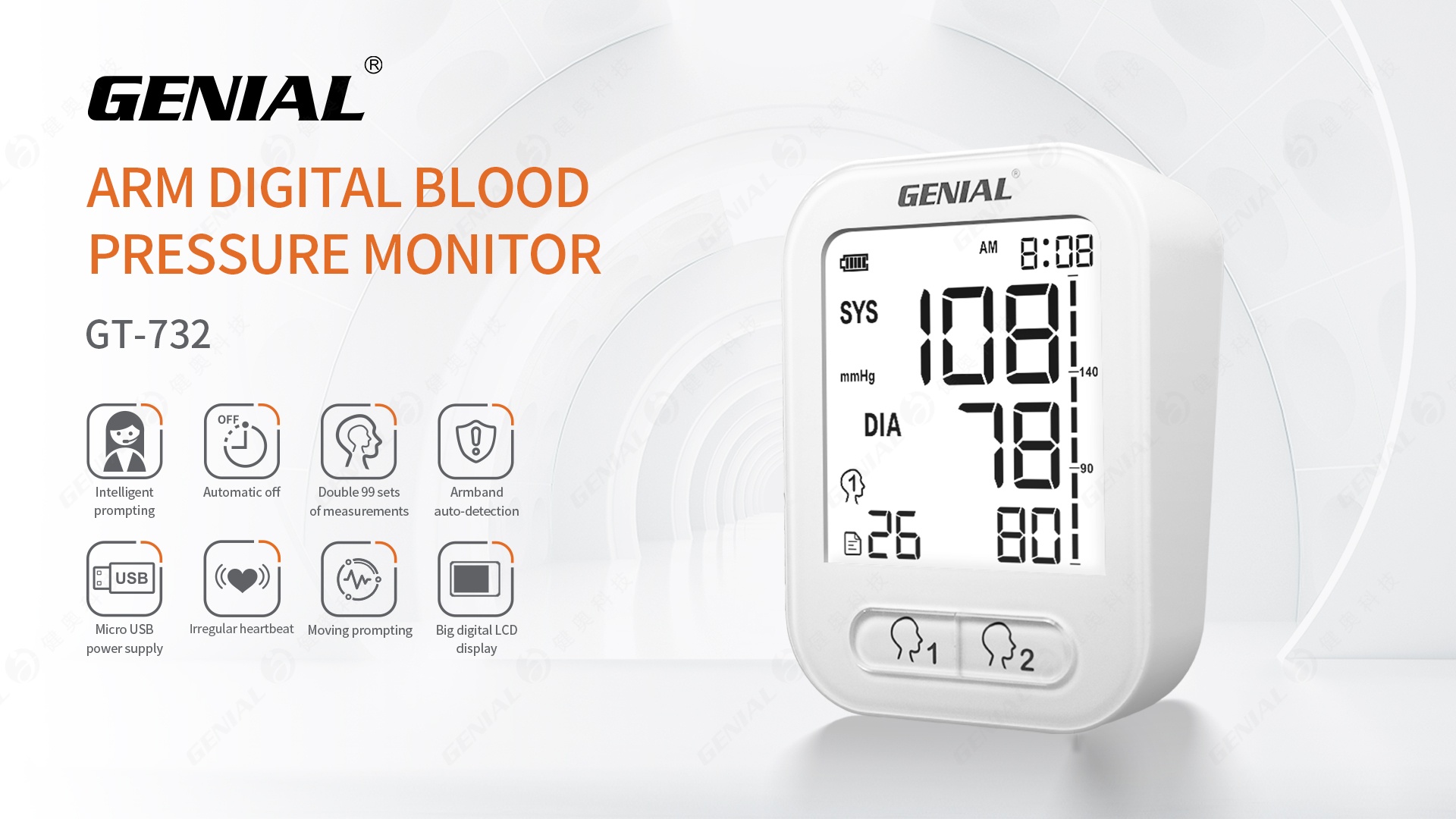
GT-732 upper arm digital blood pressure monitor: pressure measuring range 0~290 mmHg, pulse tolerance ±5%, ABS housing with PVC air bag and nylon binding strap.
Problem Definition: Why Pressure Range and Pressure Accuracy Are Not the Same Specification
The first confusion is semantic. A measuring range of 0~290 mmHg is a span, not a tolerance. It states that the sensor, valve and cuff assembly are designed to operate between 0 and 290 mmHg and that the full inflation-and-deflation curve of a normal measurement falls inside that window. It does not state how closely a displayed value tracks a reference pressure. Buyers comparing specification sheets often read the range as a quality claim and never reach the line that describes tolerance.
The second confusion is practical. Blood pressure values naturally move with posture, cuff placement, time of day and recent activity, so a user cannot visually detect whether the pulse channel is drifting. Yet the pulse channel is not decorative: on GENIAL blood pressure monitors the device measures systolic pressure, diastolic pressure and pulse rate, applies WHO blood-pressure classification indication, and can support irregular-heartbeat detection and dual-user memory storage. If the pulse specification is loose or unpublished, the long-term trend record that a chronic disease management programme depends on becomes softer than it appears on screen.
The third confusion is structural, and it is invisible on a one-page datasheet. Two upper arm monitors can share an identical pressure range, identical housing dimensions and near-identical weight, yet be built with a different air bag material and a different cuff fabric. Those differences do not change the headline specification, but they do change how the cuff holds pressure across repeated inflation cycles and how it grips different arm circumferences.
Industry Background: Why Specification Discipline Matters More in Digital Home Monitoring
The commercial weight of this category is significant. The global blood pressure monitoring devices market was valued at USD 4.2 billion in 2025 and is estimated to reach USD 8.6 billion by 2033, a CAGR of 9.3% (Grand View Research). Within that market, digital blood pressure monitors accounted for approximately 48% of total revenue share in 2024 (Fortune Business Insights). In other words, digitally measured blood pressure is not a niche accessory — it is the dominant revenue segment of a category that is still expanding.
Regulatory expectations have moved in parallel. Blood pressure monitors are registered in China as NMPA Class II medical devices with a metrology certificate, and export programmes typically require FDA, CE, FCC, GCC, MDR, RoHS and IECEE CB certification depending on the destination market. Medical electrical equipment — which includes home health devices — must also satisfy IEC 60601-1-2 for electromagnetic compatibility. That standard deserves attention in a home setting, where a monitor may sit next to a router, a phone and a Bluetooth gateway at the same time.
GENIAL — formally Guangdong Genial Technology Co., Ltd., founded in 2001 — is a manufacturer of home medical health devices with a 45,000 sqm production base, 251 employees, an annual output of 15,000,000 units, 29 R&D engineers, 262 intellectual property certificates, and customers in 117 countries and regions. Its blood pressure monitor range spans wrist and upper arm formats; this article deals with the upper arm family, where the pressure and pulse specifications are most consistently published.
Reading the Two Core Specifications Correctly
Pressure measuring range: 0~290 mmHg
Every upper arm model in the published specification set carries the same pressure measuring range: 0~290 mmHg. That consistency matters for project buyers, because it means the cuff is inflated above the user's systolic pressure and released through a full deflation curve inside a single, uniform operating window, regardless of which model is chosen within the family. The range must be wide enough to cover inflation overshoot above systolic pressure and to register the complete bleed-down sequence — which is why a range, not a fixed value, is the correct way to express it.
What 0~290 mmHg does not mean is that any two monitors sharing that figure will report pressure identically. The range defines where the device works; it does not define how tightly it works. This is the single most useful distinction a buyer can carry into a supplier conversation.
Pulse error: ≤±5%, expressed as a percentage rather than a fixed number
GENIAL's upper arm specification set states the pulse limit in two equivalent ways: “pulse tolerance ±5%” on GT-732 and “pulse error ≤±5%” on GT-732M. Because the tolerance is expressed as a percentage, the permitted deviation scales with the reading. The table below converts the ±5% limit into beats per minute at typical heart rates — these are arithmetic conversions of the stated limit, not additional test results.
| Displayed pulse | Permitted deviation at ±5% | Practical reading |
|---|---|---|
| 60 bpm | ±3 bpm | A resting adult's reading stays within a narrow band |
| 80 bpm | ±4 bpm | Typical seated measurement range |
| 100 bpm | ±5 bpm | Elevated or post-activity reading |
| 120 bpm | ±6 bpm | Higher-rate measurement, tolerance widens proportionally |
| 150 bpm | ±7.5 bpm | Wide tolerance band; trend interpretation needs context |
The practical conclusion is simple: a percentage-based pulse specification is the honest way to publish the number, but it also means that a single tolerance figure produces different absolute deviations at different heart rates. When a programme compares devices across a population with very different resting rates — for example a mixed elderly-care group — the wider absolute band at higher rates should be factored into how trend data is interpreted.
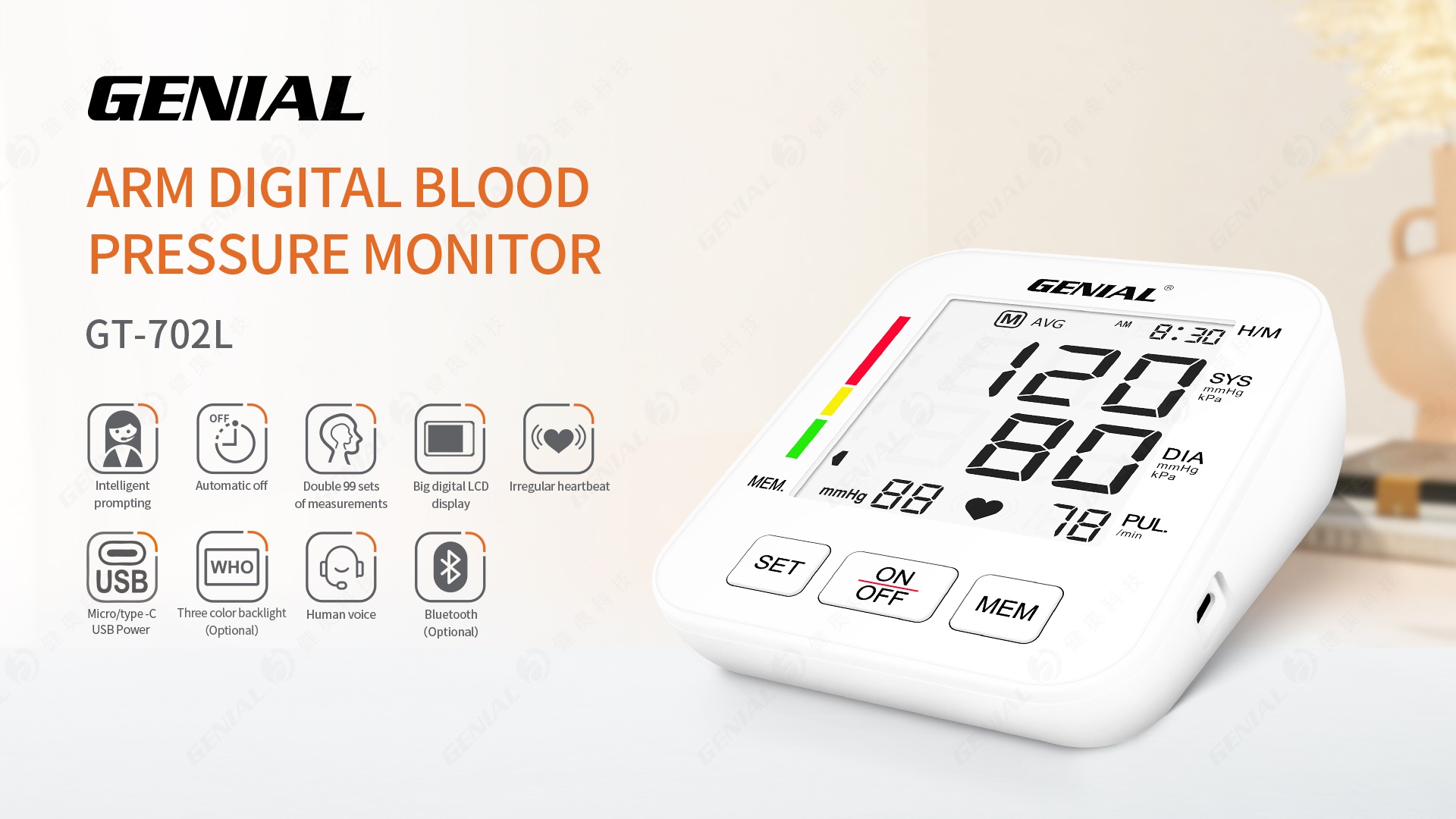
GT-702L states a pulse measuring range of 30~250 bpm alongside a 0~290 mmHg pressure range, an ABS plastic housing, a nylon cuff and an LCD lens.
Pulse measuring range: 30~250 bpm
Separate from pulse error is the pulse measuring range. GT-702L publishes a pulse range of 30~250 bpm within its pressure range of 0~290 mmHg. For project buyers this is the coverage figure: it indicates the span across which the pulse channel is designed to register a rate at all, from a low resting rate through to a markedly elevated one. Coverage and tolerance should always be checked together — a wide pulse range with an unpublished error limit leaves the tolerance question open.
What these specifications still do not tell you
- Pressure tolerance is a separate line item. The published set defines the pressure range (0~290 mmHg) but does not present a pressure-accuracy tolerance for these models. Range is not accuracy, and no specification sheet should be read as if it were.
- ±5% applies to the pulse channel, not to the blood pressure values. Systolic and diastolic reporting depends on the cuff, the valve and the measurement algorithm, not on this figure alone.
- Specifications hold inside a stated environment. The blood pressure monitoring scenario is specified for indoor operation at 5~40°C and 15%~85% RH. Measurements taken outside that envelope — a cold balcony, a damp bathroom — fall outside the conditions the specification covers.
- User-side error is not in the datasheet. Cuff size mismatch, arm position and body movement during inflation are error sources that no pulse-error figure can absorb.
Materials and Reading Reliability: ABS, Modified ABS, PVC and TPU
Housing and cuff materials are where two superficially identical upper arm monitors diverge. GENIAL's specification set names them explicitly, which makes the family unusually easy to compare on this dimension.
ABS is the default housing material across most of the upper arm range — GT-702L lists “ABS plastic, Nylon cuff, LCD lens.” The rigid enclosure carries the LCD module, the pressure sensor and the valve assembly, and it is the part of the device that absorbs handling in daily home use, pharmacy counters and multi-user screening stations.
Modified ABS appears on GT-702VA, which is also the lightest upper arm model in the specification set at 155 g ±15 g (without battery). Weight matters more than it first appears: a lighter upper arm unit is easier to hold steady and easier to store in a carrying bag, while a heavier unit sits more firmly on a table during a seated measurement.
Air bag and cuff materials determine how pressure is physically held. The specification set distinguishes between a PVC air bag with a nylon binding strap (GT-732), an eco-friendly TPU air bag (GT-732M), a composite fabric cuff (GT-702BM), and a nylon cuff (GT-702L). The GT-732 and GT-732M pair is the clearest illustration available: both are listed at identical 136×103×54 mm housing dimensions, yet GT-732 is 291 g ±15 g and GT-732M is 239 g ±15 g (both without battery). Same footprint, different air bag construction, roughly 52 g of difference — a reminder that external dimensions alone say very little about what is inside the cuff.
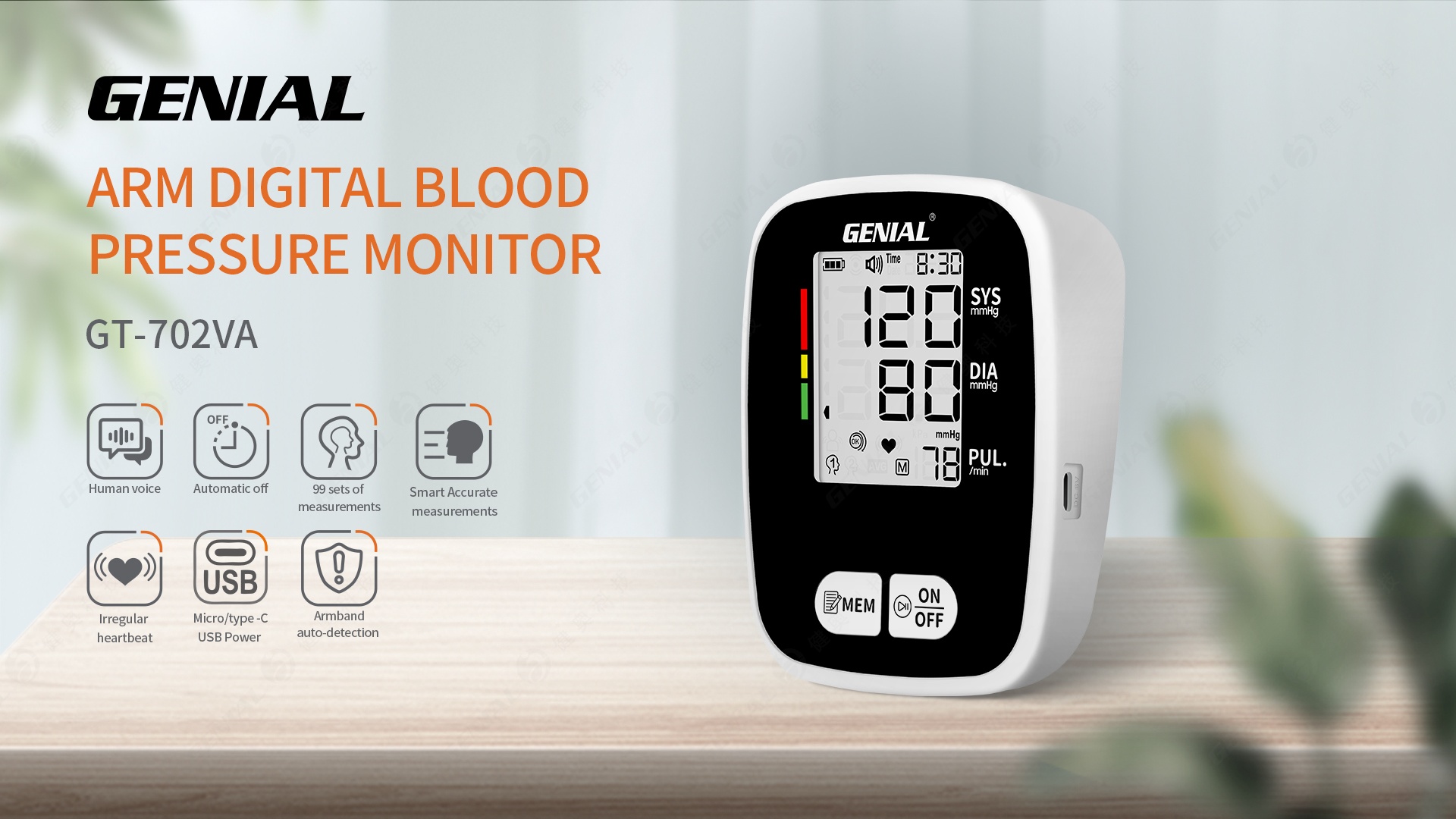
GT-702VA uses a modified ABS housing and is listed at 155 g ±15 g without battery — the lightest upper arm model in the published set.
| Material element | Where it is specified | What it means when you evaluate |
|---|---|---|
| ABS housing | GT-732, GT-702L, GT-702M, GT-702LM, GT-702LD, GT-702BM, GT-703M, GT-703V, GT-702V, GT-702, GT-702B, GT-702C, GT-702D, GT-712B/C/E | Standard rigid enclosure; carries LCD, sensor and valve assembly |
| Modified ABS housing | GT-702VA | Weight-optimised housing; lightest upper arm model at 155 g ±15 g |
| PVC air bag + nylon binding strap | GT-732 | Bladder plus strap fastening; 22~32 cm arm range |
| Eco-friendly TPU air bag | GT-732M | Alternative bladder material at the same 136×103×54 mm footprint; 22~42 cm range |
| Composite fabric cuff | GT-702BM | Paired with 99 memory sets for 2 users; 22~42 cm range |
| Nylon cuff + LCD lens | GT-702L | Pulse range published at 30~250 bpm; 22~42 cm range |
| ABS + TPU | GT-702MA | WHO blood-pressure classification function; 22~42 cm range |
Step-by-Step: How to Evaluate an Upper Arm Monitor Specification Sheet
The following sequence follows the order in which the specifications actually constrain a decision. It can be applied to GENIAL models or used as a neutral checklist against any supplier's datasheet.
- Confirm the pressure measuring range. On this family it is 0~290 mmHg across all upper arm models. Record it as a coverage figure, not an accuracy claim.
- Locate the pulse error or pulse tolerance. GT-732 publishes ±5% tolerance; GT-732M publishes ≤±5% error. If a datasheet omits this line, treat the omission as an open question rather than a zero.
- Check whether a pulse measuring range is published. GT-702L states 30~250 bpm. Coverage plus tolerance gives a complete pulse picture; either one alone does not.
- Match cuff circumference to the user population. The set divides into 22~32 cm (GT-732, GT-702, GT-702B, GT-702C, GT-702D, GT-712B/C/E, GT-702CM, GT-702CD are listed at 22~42 cm — verify per model) and 22~42 cm (GT-732M, GT-702MA, GT-702LM, GT-702LD, GT-702V, GT-702V, GT-702M, GT-703M, GT-703V, GT-702VA, GT-702BM, GT-702L). Wider ranges suit mixed-population programmes; narrower ranges suit a more homogeneous retail audience.
- Identify the air bag and cuff material. PVC versus eco-friendly TPU, composite fabric versus nylon — this determines how pressure is held across repeated cycles.
- Check the memory and classification features. GT-702BM and GT-702V publish 99 memory sets for 2 users; GT-702MA publishes a WHO blood-pressure classification function. Both features shape how usable the device is in a chronic disease management programme.
- Weigh the unit in context. The upper arm family spans roughly 155 g to 291 g ±15 g without battery, from GT-702VA at the light end to GT-732 at the heavy end.
- Confirm the compliance file for the destination market. NMPA Class II registration with metrology certificate for the domestic market; FDA, CE, FCC, GCC, MDR, RoHS and IECEE CB as required for export, with IEC 60601-1-2 electromagnetic compatibility applying to the device as medical electrical equipment.
- Confirm what ships in the box. The blood pressure monitoring scenario lists a cuff, batteries, a power adapter, a storage bag and APP support as supporting equipment.
- Validate with a physical sample before mass production. Specification sheets describe intent; a sample confirms cuff fit, pulse behaviour and housing feel on the actual user population.
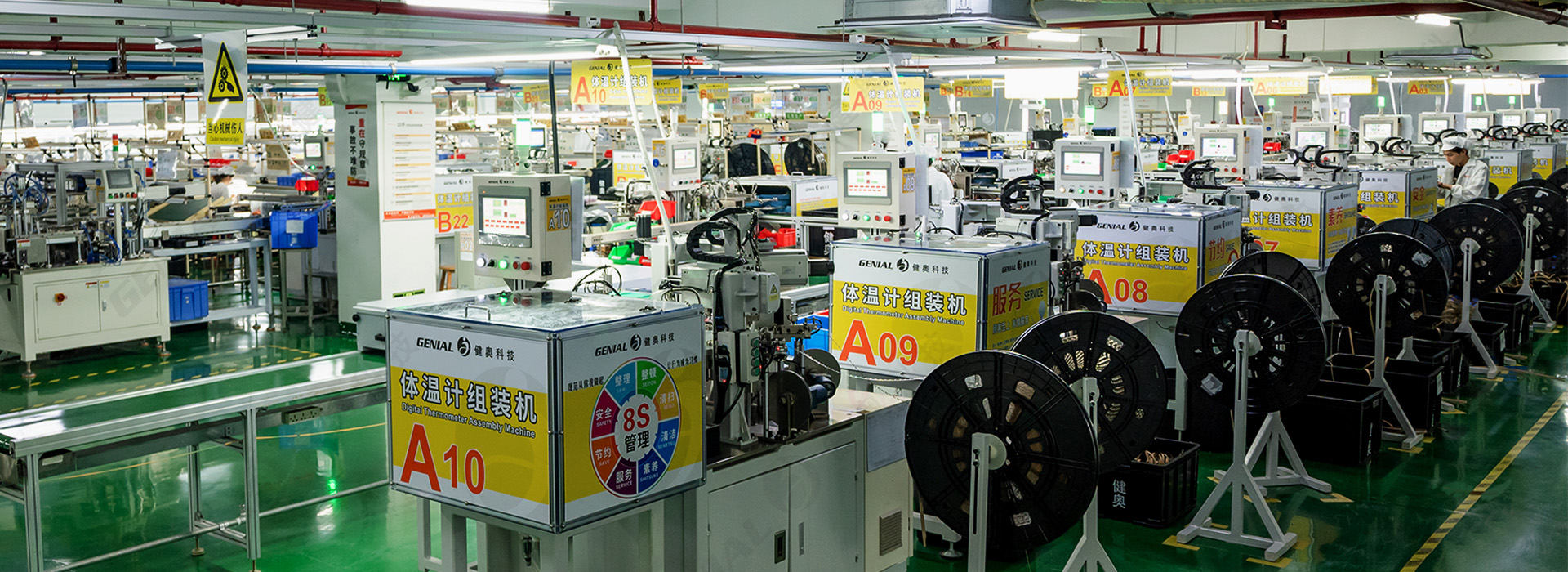
Production workshop at GENIAL's 45,000 sqm base, where incoming material inspection, full-process production inspection and final factory inspection precede shipment.
Project and Scenario Fit: Matching the Specification Level to the Deployment
Because the pulse and pressure specifications are uniform across the upper arm family, scenario fit is decided by cuff range, feature set and materials rather than by the headline numbers.
- Community chronic disease management and physical examination centres. A 22~42 cm arm range (GT-702MA, GT-703M, GT-702LM) accommodates a broader adult population, and the WHO blood-pressure classification function on GT-702MA gives screening staff a standard reference frame. The 99-memory, dual-user configuration on GT-702BM and GT-702V suits repeat visits.
- Elderly care and wellness institutions. Wider cuff coverage and stable housing weight support repeated seated measurements across residents; the ±5% pulse limit should be read against the higher absolute deviation that occurs at elevated heart rates.
- Pharmacy chains and retail counters. GT-702LM is specified for global supermarket channels and medical equipment distributors; GT-702C for pharmacy and seasonal promotional programmes.
- Community health service centres and household markets. GT-702LD is specified for community health service centres and the domestic household market, where a compact 135×110×39 mm body at 209 g ±15 g supports frequent handling.
- Cross-border e-commerce and private label programmes. GT-703V is specified for e-commerce sales and private label customisation, with a 22~42 cm arm range and 195 g ±15 g body.
- Insurance, gift and promotional projects. GT-732M and GT-702VA are specified for insurance promotional and complimentary gift programmes, where packaging and unit cost carry more weight than feature depth.
- Ambulatory and low-cost entry programmes. The wrist formats GT-701, GT-701L, GT-701C and GT-701F share the same 0~290 mmHg pressure range, with GT-701F also publishing a 30~250 bpm pulse range — useful where portability outweighs cuff-width flexibility.
Model Comparison: Upper Arm Monitors by Pulse Specification, Cuff Range and Material
| Model | Pressure range | Pulse specification | Arm circumference | Body / cuff material | Net weight |
|---|---|---|---|---|---|
| GT-732 | 0~290 mmHg | Tolerance ±5% | 22~32 cm | ABS, PVC air bag, nylon binding strap | 291 g ±15 g |
| GT-732M | 0~290 mmHg | Error ≤±5% | 22~42 cm | ABS, eco-friendly TPU air bag | 239 g ±15 g |
| GT-702L | 0~290 mmHg | Pulse 30~250 bpm | 22~42 cm | ABS plastic, nylon cuff, LCD lens | 220 g ±15 g |
| GT-702MA | 0~290 mmHg | Not published in set | 22~42 cm | ABS, TPU | 204 g ±15 g |
| GT-702BM | 0~290 mmHg | Not published in set | 22~42 cm | ABS, composite fabric cuff | 220 g ±15 g |
| GT-702VA | 0~290 mmHg | Not published in set | 22~42 cm | Modified ABS | 155 g ±15 g |
| GT-703M | 0~290 mmHg | Not published in set | 22~42 cm | ABS | 220 g ±15 g |
| GT-703V | 0~290 mmHg | Not published in set | 22~42 cm | ABS | 195 g ±15 g |
The table also explains why pulse error should be requested explicitly during supplier evaluation: several models in the family publish the pressure range and cuff range without a published pulse figure. For those models, the pulse tolerance is simply not stated in the available specification set — and a procurement team should ask for it rather than assume it matches the models that do publish it.
Frequently Asked Questions
1. What certifications should an upper arm blood pressure monitor carry before export?
GENIAL blood pressure monitors are registered as NMPA Class II medical devices with a metrology certificate for the domestic market. For export, the certification set covers FDA, CE, FCC, GCC, MDR, RoHS and IECEE CB as applicable to the destination market, and medical electrical equipment including home health devices must also satisfy IEC 60601-1-2 for electromagnetic compatibility. At company level, GENIAL holds ISO 13485, ISO 45001, ISO 14001, BSCI and GB/T29490 system certifications, has completed product and trademark registration in 29 countries, and supplies customers in 117 countries and regions.
2. Can cuff material, housing material or firmware be customised for a specific project?
Yes, within defined customisation scopes. Under ODM, customisation covers industrial design, tooling, structure, PCB firmware, algorithms, Bluetooth functionality, display interface, packaging system and exclusive product model registration. Under OEM, customisation covers packaging, gift box, user manual, product logo printing, colour schemes and packaging specifications, while core hardware, PCB and key functions remain unchanged. Under JDM, the customer participates in product definition while GENIAL provides hardware, software and structural R&D, with intellectual property allocated according to the contract. Monthly capacity ranges from 60,000 to 6,000,000 units.
3. What drives the cost of an upper arm monitor project?
Cost is driven by specification choices rather than by a single list price. The main variables are housing material (standard ABS versus modified ABS), air bag type (PVC versus eco-friendly TPU), cuff fabric and circumference range (22~32 cm versus 22~42 cm), the feature set (99 memory sets for 2 users, WHO blood-pressure classification), and the tooling and order structure. Order thresholds in the published set are 2,000 units for blood pressure monitors under OEM, 5,000 units for product modification, and 10,000 units for new mould development, with tooling cost refundable for large-volume projects.
4. How quickly can a sample be delivered and validated?
OEM samples are quoted at 3 days. For ODM projects the sequence runs from customer demand assessment and internal project approval through product development, sample approval, exclusive model registration and finally mass production. During validation, the checks that matter most for this specification family are cuff fit across the target circumference range, pulse display behaviour, and the housing and air-bag material actually used in the sample.
5. What lead times apply once a specification is confirmed, and how do I start?
Under OEM, samples take 3 days, small orders 3~7 days and mass orders 10~15 days. Under ODM, minor modifications without new tooling take 7~15 days, while new mould development takes 45~50 days. JDM projects are quoted at 45~60 days, and OBM in-stock products ship within 48 hours with replenishment orders at 5~7 days. To move from specification to sample, send your target model, cuff range and pulse specification to market6@genial.cn or WhatsApp (+86) 18938327866, and GENIAL will confirm the matching configuration and quotation.
Conclusion: Read the Tolerance, Not Just the Range
Upper arm blood pressure monitors are usually shortlisted on features and screen size, but the specifications that determine whether the data is trustworthy are quieter. The pressure measuring range of 0~290 mmHg tells you where the device works; the pulse error of ≤±5% tells you how far a displayed pulse value may move; the cuff circumference tells you who the device actually fits; and the air bag and housing material tells you how consistently it will hold pressure over years of repeated cycles. GT-732 and GT-732M illustrate the point neatly — identical housing dimensions, different air bag construction, and a 52 g difference in net weight.
For project buyers, the practical takeaway is a three-line request: state the pulse tolerance you require, state the arm circumference range your population needs, and state the air bag and cuff material you will accept. Everything else in the specification set can then be compared on equal terms.
Request a Sample or a Project Quotation
GENIAL supplies upper arm and wrist digital blood pressure monitors with a 0~290 mmHg pressure range and pulse specifications published per model, supported by OEM, ODM, JDM and OBM programmes, a free 12-month warranty with valid proof of purchase, and certification documentation support.
Email: market6@genial.cn | WhatsApp: (+86) 18938327866 | Website: www.cngenial.com
Download the full 2026 English product catalogue: GENIAL Home Medical Health Devices Catalogue (PDF)
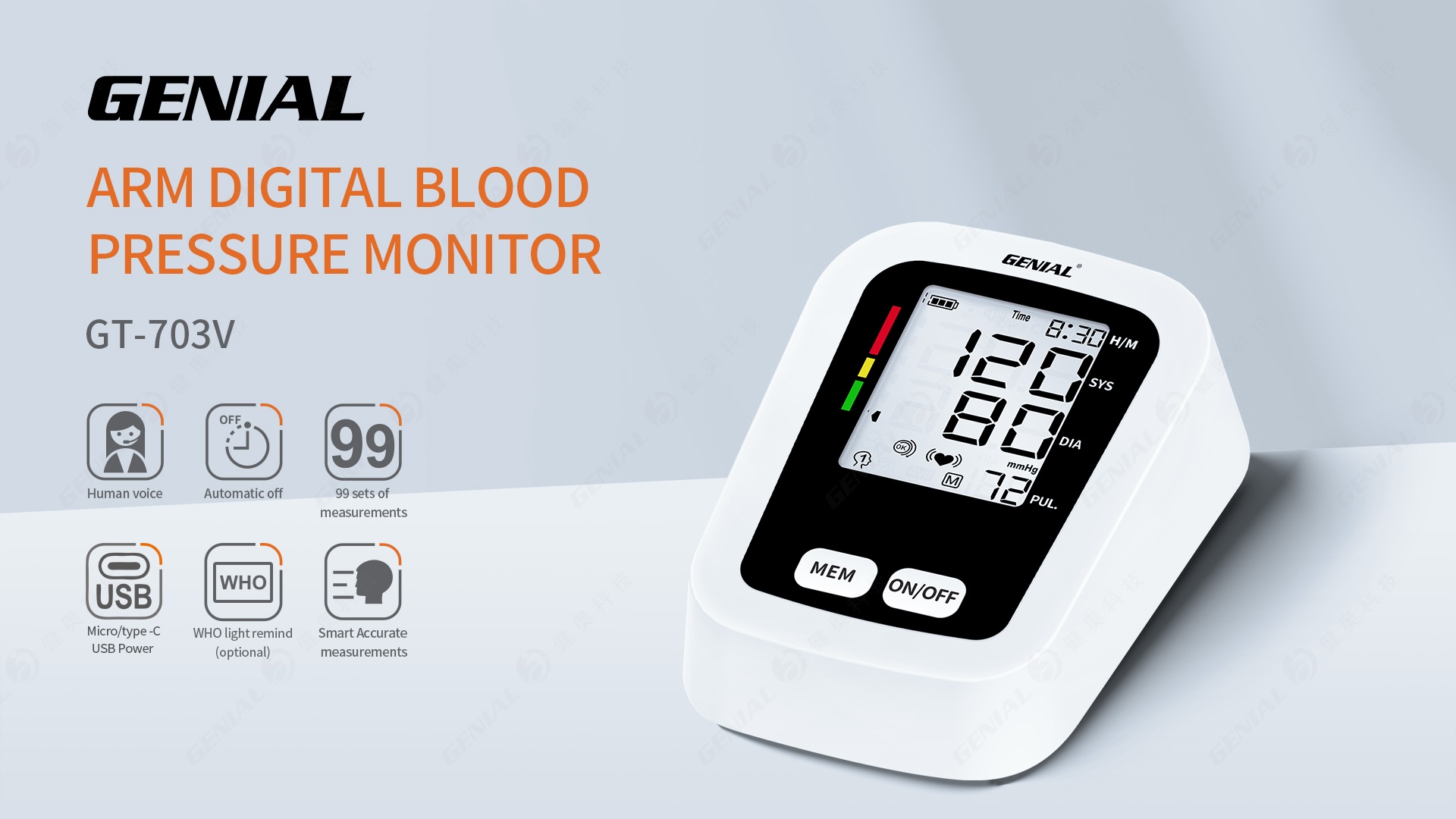
GT-703V upper arm digital blood pressure monitor, specified for e-commerce sales and private label customisation, 22~42 cm arm circumference.
Specification note: all model parameters, materials and certifications quoted in this article are taken from GENIAL's published product and capability documentation. Where a specification is not published for a specific model, this article states that it is not published rather than estimating a value.
Have Questions or Need More Details?
Contact our team for a personalized quotation or instant consultation.
Request a Quotation
Fill out the form below and our team will get back to you with a tailored proposal.
WhatsApp Direct Chat
Prefer to chat in real-time? Message us on WhatsApp for instant assistance & quick answers.
- Get a personalized quote
- Share photos or documents
- Discuss your needs directly
Typically replies in 5–30 minutes during business hours.