
Home Medical Health Devices: Trending Categories and 2026 OEM Evaluation

The home medical health devices market is not moving as a single market. Blood pressure monitors, digital thermometers, pulse oximeters, and mesh nebulizers each have distinct growth rates, regulatory requirements, and channel dynamics. For procurement teams and product managers at the evaluation stage, the first decision is category priority, and the second is supplier capability. This article ranks the main home medical health device categories using verified third-party market data, sets out a step-by-step OEM evaluation framework, and uses Guangdong Genial Technology Co., Ltd. (GENIAL) as a reference manufacturer.
GENIAL is an original medical device manufacturer established in 2001, operating a 45,000㎡ manufacturing base with an annual output of 15,000,000 units and 251 employees including 29 R&D engineers. Its product portfolio covers electronic thermometers, blood pressure monitors, pulse oximeters, mesh nebulizers, sleep apnea therapy devices and related home-use products. The company provides OEM, OBM, ODM and JDM services to global clients, exports to Europe, North America, Southeast Asia, the Middle East, Africa, Latin America and Oceania, and reports an export ratio of approximately 80%.
Why Category Selection and Supplier Selection Must Be Evaluated Together
Buyers evaluating home medical health devices typically face two linked problems. The first is category prioritization: which devices should a new line, a private-label portfolio, or a hospital supply contract include? The second is supplier identification: which manufacturer can cover the chosen categories with the right certifications, capacity, customization depth and delivery terms?
Treating these as separate decisions creates concrete risks. A distributor that prioritizes blood pressure monitors based on market size may still fail if its supplier has no FDA 510(k) coverage for the United States or no CE MDR certification for the European Union. An e-commerce brand that wants a wearable infant thermometer may discover that its supplier cannot support Bluetooth firmware development or medical-grade material selection. Choosing a supplier before defining the category mix can also lock a buyer into a narrow product range that does not match channel demand.
A practical evaluation therefore needs two inputs: verified market signals for each category, and documented manufacturer evidence across compliance, capacity, customization, MOQ and lead time.
Industry Background: Market Signals by Device Category
Third-party market research provides several verifiable reference points for ranking home medical health device categories.
Blood Pressure Monitoring Devices: Largest and Most Stable
The global blood pressure monitoring devices market was valued at approximately USD 4.2 billion in 2025 and is estimated to reach USD 8.6 billion by 2033, representing a CAGR of 9.3% (Grand View Research). Digital blood pressure monitors accounted for approximately 48% of total market revenue in 2024 (Fortune Business Insights). For buyers, this confirms that upper-arm and wrist digital BP monitors remain the volume product in home monitoring, driven by chronic disease management and aging populations.
Digital Thermometers: Mature, Universal and Steady
The global digital thermometer market was valued at approximately USD 805.1 million in 2024 and is projected to reach USD 1 billion by 2030 (Research and Markets). Within this category, contact digital thermometers, infrared forehead thermometers, ear thermometers and wearable continuous thermometers serve different segments. Clinical electronic thermometers must also comply with safety and performance requirements such as ISO 80601-2-56:2017, which matters when products are destined for hospital procurement rather than household use only.
Pulse Oximeters: Fast-Growing Respiratory Monitoring
The global pulse oximeter market is expected to reach USD 5.3 billion by 2030, with a CAGR of 6.6% from 2024 to 2030 (Grand View Research). Fingertip pulse oximeters are widely used in elderly care, respiratory departments and home monitoring, making this category a strong complement to thermometers and BP monitors.
Vibrating Mesh Nebulizers: Smaller Base, Clear Upward Trend
The vibrating mesh nebulizer market was valued at USD 0.75 billion in 2024 and is expected to grow to USD 1.57 billion by 2035 (Market Research Future). Although smaller than the BP monitor market, mesh nebulizers are a rising category in pediatric and home respiratory care, and they require specific technical parameters such as particle size and nebulization rate.
For competitive context, Omron Healthcare remained a dominant competitor in the global nebulizer and blood pressure monitor markets as of 2024 (iData Research). For brands entering these categories, differentiation therefore comes from product specification, certification coverage, channel fit and service rather than from competing on name recognition with an established incumbent.
Based on these verified signals, the top-ranked categories for a home medical health device portfolio in 2026 are:
- Blood pressure monitoring devices – largest market base and sustained growth.
- Pulse oximeters – strong growth tied to respiratory monitoring.
- Digital thermometers – stable universal household demand.
- Vibrating mesh nebulizers – smaller but rising respiratory care segment.
Detailed Solution: Building a Category Portfolio Around One Quality System
Once category priorities are set, the evaluation moves to supplier capability. A manufacturer with a full-family portfolio reduces the number of quality audits, compliance dossiers and logistics relationships a buyer must manage. GENIAL’s portfolio maps directly to the ranked categories above.
Digital and infrared thermometers. The thermometer line includes rigid tip and flexible tip digital thermometers (T11/T12, T14/T14SL/T14Y, T19C/T19D, T23/T24, T28), pediatric animal-shaped thermometers (T15S/T15SL/T15SC), non-contact infrared forehead thermometers (T86/T87 with ±0.2°C error at 35–42°C), voice-broadcast infrared forehead thermometers (T81/T80), infrared ear thermometers (T94, T90/T92), and the wearable Bluetooth thermometer T31, which measures 20.0–45.0°C with ±0.1°C accuracy and IPX4 whole-body splash-proof protection.
Digital blood pressure monitors. The BP monitor line covers upper-arm models GT-702, GT-703, GT-712, GT-732 and wrist models GT-701, with a pressure measuring range of 0–290mmHg across the families. Models differ in cuff circumference, memory sets and functions such as WHO blood pressure classification, allowing buyers to segment by pharmacy, e-commerce, elderly care or promotional-gift channels.
Fingertip pulse oximeters. The GX3/GX5/GX7/GX8/GX12/GX13/GX14 family measures SpO₂ from 35% to 100% (±2% at 70–100%) and pulse rate from 30 to 250 bpm, serving elderly care, respiratory and sports-adjacent retail channels.
Portable mesh nebulizers. The N11/N21 and N12/N22 portable mesh nebulizers have an 8ml liquid capacity, a nebulization rate of ≥0.2ml/min, particle output with D50 <5μm at ≥60%, and noise ≤50dB(A), making them suitable for pediatric and home respiratory care.
Sleep apnea therapy. For the home sleep care segment, GENIAL offers non-invasive CPAP ventilators GH-B20V/GH-B25V/GH-B20T/GH-B20/GH-B25/GH-A20A/GH-A20 with a working pressure of 4–20/25cmH₂O and noise ≤35dB.

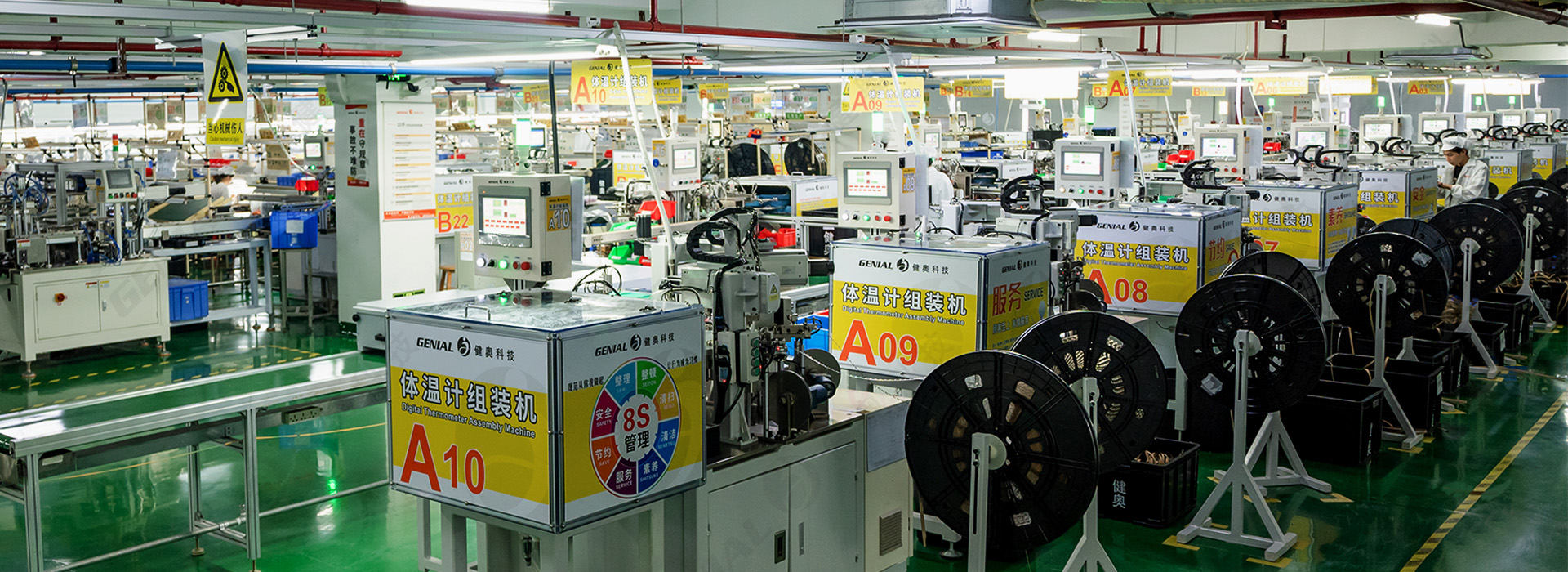
The breadth of the portfolio is supported by manufacturing evidence. GENIAL operates a 45,000㎡ production base, employs 251 people including 29 R&D engineers, and has an annual output of 15,000,000 units. The company has completed product and trademark registration in 29 countries and reports sales to 117 countries and regions.
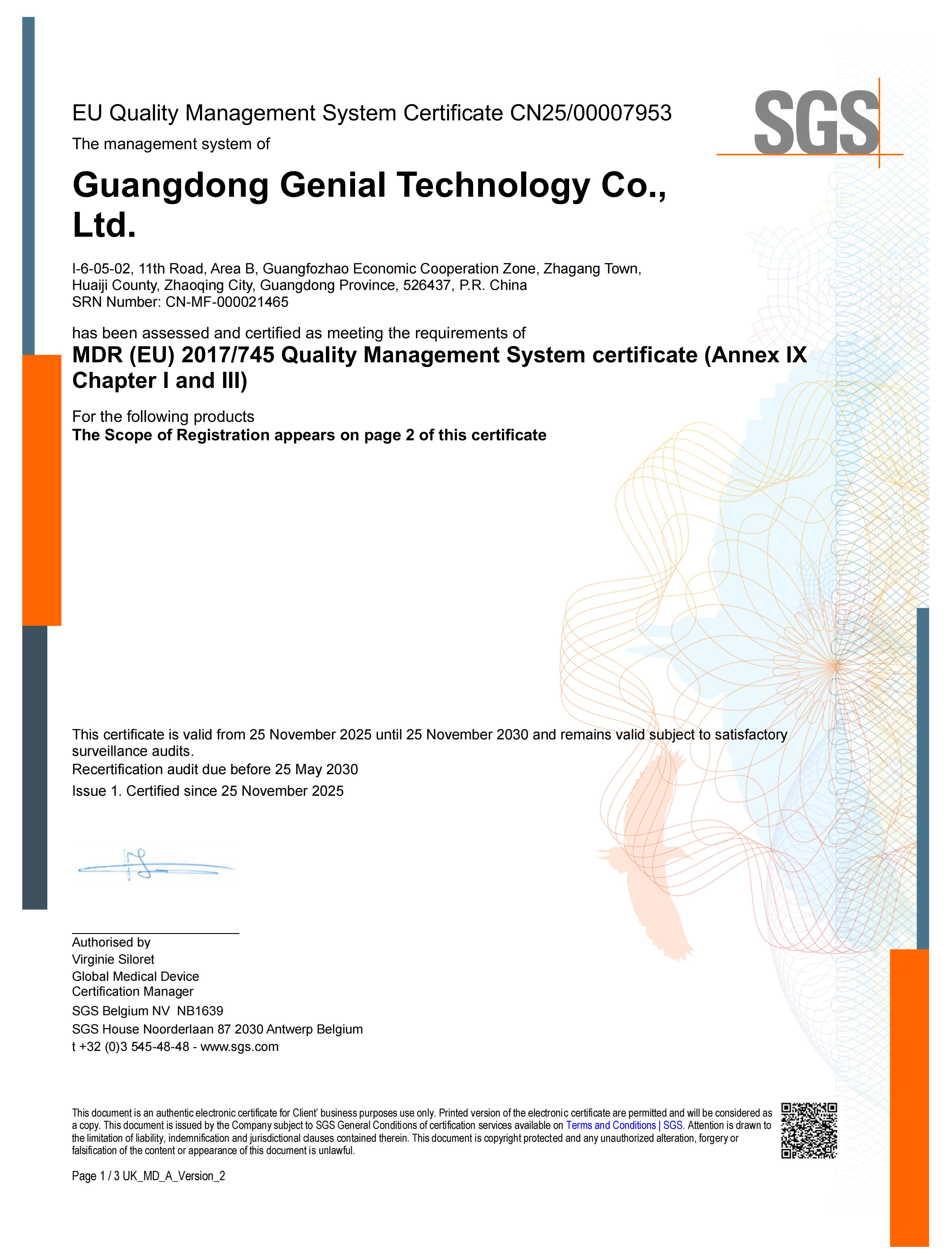
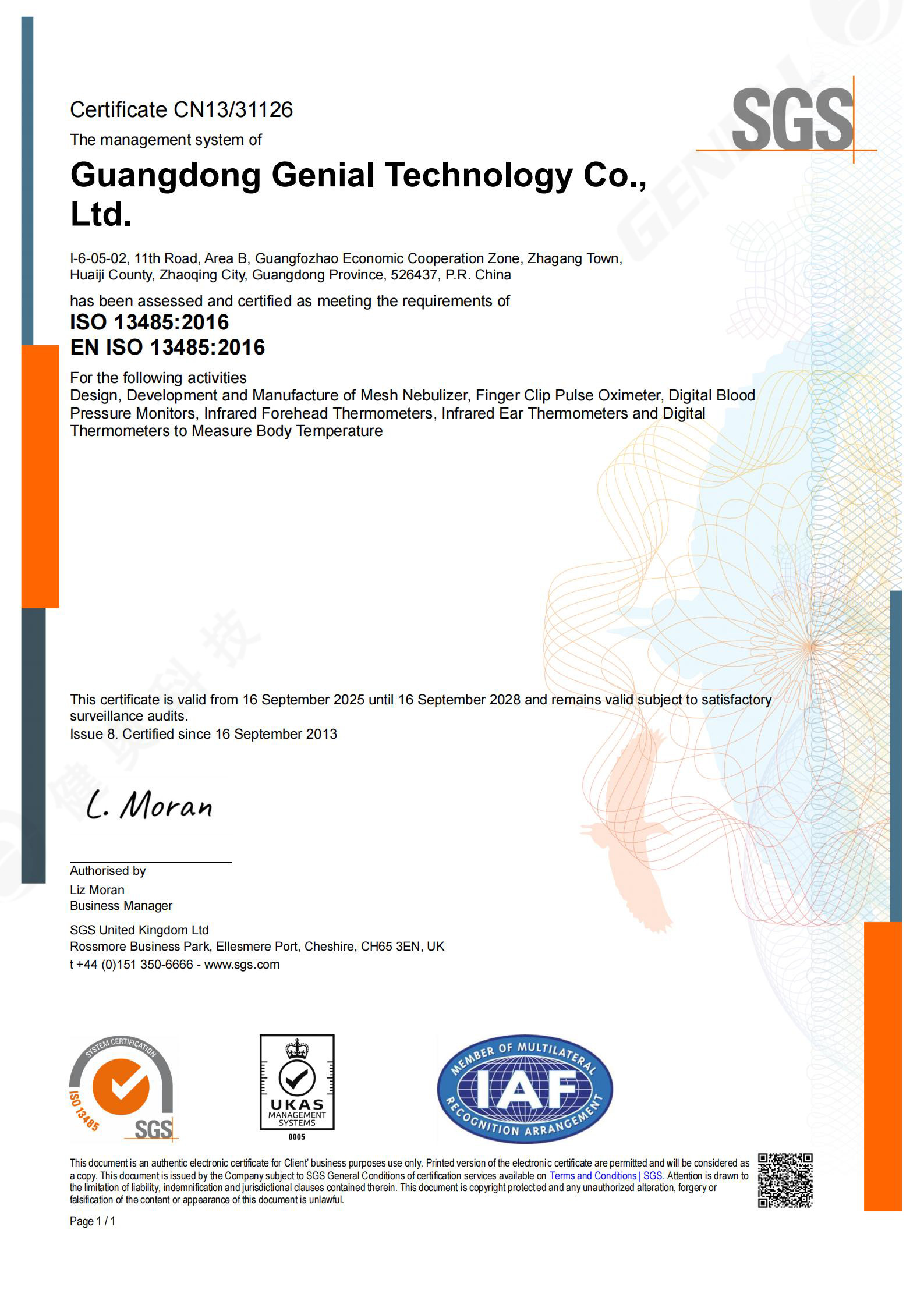
On the compliance side, GENIAL holds ISO 13485:2016 certification (cert. CN13/31126, issued by SGS United Kingdom) covering mesh nebulizers, finger clip pulse oximeters, digital BP monitors, infrared forehead and ear thermometers, and digital body thermometers. For the European market, CE MDR certification under (EU) 2017/745 is held for digital blood pressure monitors and related families (cert. CN25/00007953, SGS Belgium NV, Notified Body 1639), and the wearable thermometer T31 and fingertip pulse oximeter series hold a separate CE MDR quality management system certificate (cert. 195/MDR, IMQ, Notified Body 0051). For the United States market, GENIAL holds FDA 510(k) premarket notifications across infrared forehead thermometers, clinical electronic thermometers, continuous reading thermometers, the wearable thermometer T31, arm-type and wrist-type BP monitors, and fingertip pulse oximeters.
Social compliance and management systems are also available as documented evidence: BSCI (overall rating B), ISO 14001, ISO 45001, and GB/T 29490 intellectual property management, plus national registrations including MHRA (Great Britain), MHLW foreign manufacturer registration (Japan), ANVISA (Brazil) and Roszdravnadzor (Russia). GENIAL has independently developed the Genial Cloud Health Management Platform and holds 262 intellectual property certificates, which is relevant for ODM projects involving firmware, Bluetooth connectivity or app integration.
Step-by-Step: How to Evaluate an OEM Partner for Home Medical Health Devices
Step 1. Rank category priorities with verifiable data
Use market size, growth rate and channel demand to decide the product mix. The verified data in this article supports prioritizing BP monitors, then pulse oximeters, digital thermometers and mesh nebulizers for a general home-health portfolio. For a pediatric-specific line, wearable thermometers and mesh nebulizers may move up in priority.
Step 2. Verify compliance market by market
Ask for certificate numbers and issuer details, then check them against the target market. For the EU, verify CE MDR status under (EU) 2017/745. For the US, verify FDA 510(k) numbers for each product family. For Brazil, Japan, Russia or the UK, confirm ANVISA, MHLW, Roszdravnadzor or MHRA coverage. A supplier should be able to name the certificate number, issuer and scope.
Step 3. Assess manufacturing capacity and quality control
Review factory size, annual output, workforce and R&D structure. Confirm that the quality system covers design and development, not only final assembly. Documented quality control should include incoming inspection, full-process production inspection and final inspection before shipment.
Step 4. Define the cooperation mode
OEM suits buyers that need private labels with customized packaging, logo and manual. ODM suits buyers that need changes in industrial design, tooling, structure, firmware, algorithms, Bluetooth features, display interface or packaging, with exclusive model registration. OBM suits distributors that want to sell GENIAL-branded products with regional authorization. JDM suits customers that want to participate in product definition while GENIAL develops hardware, software and structure, with IP ownership allocated by contract.
Step 5. Confirm MOQ and lead time against the launch plan
For OEM, MOQs are product-specific: 10,000 pcs for thermometers; 2,000 units for infrared thermometers, blood pressure monitors, pulse oximeters, mesh nebulizers, wireless thermometers and hair removal devices; and 500 units for ventilators. ODM product modification requires 5,000 units; new mold development requires 10,000 units, with tooling cost refundable for large-volume projects. OBM accepts mixed orders from 5 cartons. JDM requires an initial mass production order of at least 10,000 units.
Step 6. Validate with samples and documentation
OEM samples are generally available within 3 days, small orders within 3–7 days, and mass orders within 10–15 days. Use the sample stage to check measurement accuracy, material quality, packaging and label compliance. At the same time, request the certificates, test reports and registration documents that your own market registration will require.
Use Cases: How Home Medical Health Device Categories Perform Across Channels
GENIAL’s documented case history shows how the same portfolio can serve very different channel strategies.
- Pharmacy chain systems (OTC sales): a global project supplied 100,000–1,000,000 units, building a rich SKU portfolio to meet different consumer segments.
- Hospitals and clinics (clinical monitoring): a global project supplied 50,000–200,000 units with automatic alerts and reduced manual inspections, improving nursing efficiency through digital management and continuous monitoring.
- Medical device distributors (medical channel distribution): a global project delivered 100,000–500,000 units over 5 years, enabling one-stop procurement and lowering supplier management costs.
- E-commerce platforms (online sales): a global project supplied 50,000–200,000 units with ODM customization and rapid product launches, supporting small-batch trial sales.
- Consumer electronics channels (retail sales): a global project supplied 50,000–100,000 units over 5 years, relying on comprehensive international certifications and stable quality for brand expansion.
- Maternal and infant companies (infant monitoring): a global project supplied 10,000–100,000 units over 5 years, using continuous infant monitoring to remove repeated nighttime temperature measurements and improve user retention.

Comparison Table: Home Medical Health Device Categories by Market Signal
| Rank & Category | Verified Market Signal | Main Home-Use Formats | GENIAL Example Families | Evaluation Emphasis |
|---|---|---|---|---|
| 1. Blood pressure monitoring devices | USD 4.2B (2025) → USD 8.6B (2033), CAGR 9.3%; digital BP ≈48% revenue share (2024) | Upper-arm and wrist digital monitors | GT-702/GT-703/GT-712/GT-732; GT-701 wrist series | Pressure range, cuff fit, memory, WHO classification |
| 2. Pulse oximeters | USD 5.3B by 2030; CAGR 6.6% (2024–2030) | Fingertip | GX3/GX5/GX7/GX8/GX12/GX13/GX14 | SpO₂ accuracy, pulse range, clinical certification |
| 3. Digital thermometers | USD 805.1M (2024) → USD 1B (2030) | Contact, infrared forehead, ear, wearable | T11–T28 contact; T86/T87 forehead; T94 ear; T31 wearable | Accuracy, measurement speed, pediatric safety |
| 4. Vibrating mesh nebulizers | USD 0.75B (2024) → USD 1.57B (2035) | Portable mesh | N11/N21; N12/N22 | Particle size, nebulization rate, noise, portability |
Interpretation: this ranking is based on market size and growth signals only, not on profitability or channel fit. A buyer focused on pediatric care may reasonably place thermometers and nebulizers above BP monitors. The table is an evaluation starting point, not a universal recommendation.
Frequently Asked Questions
Which certifications does GENIAL hold for home medical health devices in the EU and US?
For the EU, GENIAL holds CE MDR certification under (EU) 2017/745 for digital blood pressure monitors and related families (cert. CN25/00007953, SGS Belgium NV, Notified Body 1639). The wearable thermometer T31 and full fingertip pulse oximeter series also hold a CE MDR quality management system certificate (cert. 195/MDR, IMQ, Notified Body 0051). For the US, FDA 510(k) premarket notifications include K210014 for infrared forehead thermometers (T80–T87), 3016670149 for clinical electronic thermometers, K232678 for continuous reading digital thermometers, K240333 for the wearable thermometer T31, K231245 for arm-type digital blood pressure monitors, K231250 for wrist-type digital blood pressure monitors, and K231243 for fingertip pulse oximeters. The underlying quality system is certified to ISO 13485:2016 (cert. CN13/31126).
What is GENIAL’s production capacity for home medical health devices?
GENIAL operates a 45,000㎡ manufacturing base with an annual output of 15,000,000 units. The team includes 251 employees and 29 R&D engineers. The company operates a medical technology research institute, a doctoral workstation and a big health industry engineering technology research center, and holds 262 intellectual property certificates. Product and trademark registration has been completed in 29 countries, with products sold to 117 countries and regions.
What MOQ should I plan for OEM orders of home medical health devices?
OEM MOQs are product-specific: 10,000 pieces for digital thermometers; 2,000 units for infrared thermometers, blood pressure monitors, pulse oximeters, mesh nebulizers, wireless thermometers and hair removal devices; and 500 units for ventilators. For ODM projects, product modification requires 5,000 units and new mold development requires 10,000 units, with tooling cost refundable for large-volume projects. For OBM, mixed orders from 5 cartons are accepted.
Can I request samples before placing a mass order?
Yes. OEM samples are generally produced within 3 days, small orders within 3–7 days, and mass orders within 10–15 days. When requesting samples, specify the target markets and required certifications so the configuration and documentation are matched correctly.
What lead times can I expect for OEM, ODM and OBM orders?
OBM in-stock products can ship within 48 hours after order confirmation; replenishment orders take 5–7 days. OEM small orders take 3–7 days and mass orders 10–15 days. ODM minor modifications without new tooling take 7–15 days; new mold development takes 45–50 days. JDM joint development projects take 45–60 days with an initial order of at least 10,000 units. For a lead time quote matched to your product mix and volume, contact GENIAL at market6@genial.cn or +86 18938327866.
Conclusion: From Market Signal to Supplier Decision
Home medical health devices continue to show uneven but positive growth across categories. Blood pressure monitors offer the largest market base, pulse oximeters bring strong respiratory-linked growth, digital thermometers remain a universal household product, and mesh nebulizers represent a rising respiratory care segment. Buyers at the evaluation stage can use these verified signals to rank product priorities, then evaluate OEM partners against compliance documentation, manufacturing capacity, customization depth, MOQs, sample lead times and delivery terms.
Guangdong Genial Technology Co., Ltd. (GENIAL) provides a reference case for this kind of evaluation: a manufacturer founded in 2001 with a 45,000㎡ base, multi-family product coverage from thermometers to CPAP ventilators, international certifications covering the EU, US and other regulated markets, and documented projects across pharmacy, hospital, distributor, e-commerce, retail and maternal-infant channels.
To compare GENIAL against your category list and target markets, request the company brochure or send an inquiry with your product mix and estimated volumes.
Contact: Gary | Email: market6@genial.cn | Tel/WhatsApp: +86 18938327866
Address: No.2710-2711, 27/F, Bldg B, Fengxing Plaza, No.242 Tianhe Road, Tianhe Dist., Guangzhou, China
Website: www.cngenial.com | Download GENIAL 2026 English Brochure
Have Questions or Need More Details?
Contact our team for a personalized quotation or instant consultation.
Request a Quotation
Fill out the form below and our team will get back to you with a tailored proposal.
WhatsApp Direct Chat
Prefer to chat in real-time? Message us on WhatsApp for instant assistance & quick answers.
- Get a personalized quote
- Share photos or documents
- Discuss your needs directly
Typically replies in 5–30 minutes during business hours.