
Community Chronic Disease Programs: A Home Medical Device Application Guide
A community chronic disease program succeeds or fails on repetition: the same blood pressure reading, taken the same way, by the same nurse or volunteer, in a room that is not a hospital, every month for a year. Home medical health devices are what make that repetition affordable at program scale. The real planning question is therefore not which single device is good, but which device category does which job inside the program, and which configuration inside that category fits the people who actually walk in.
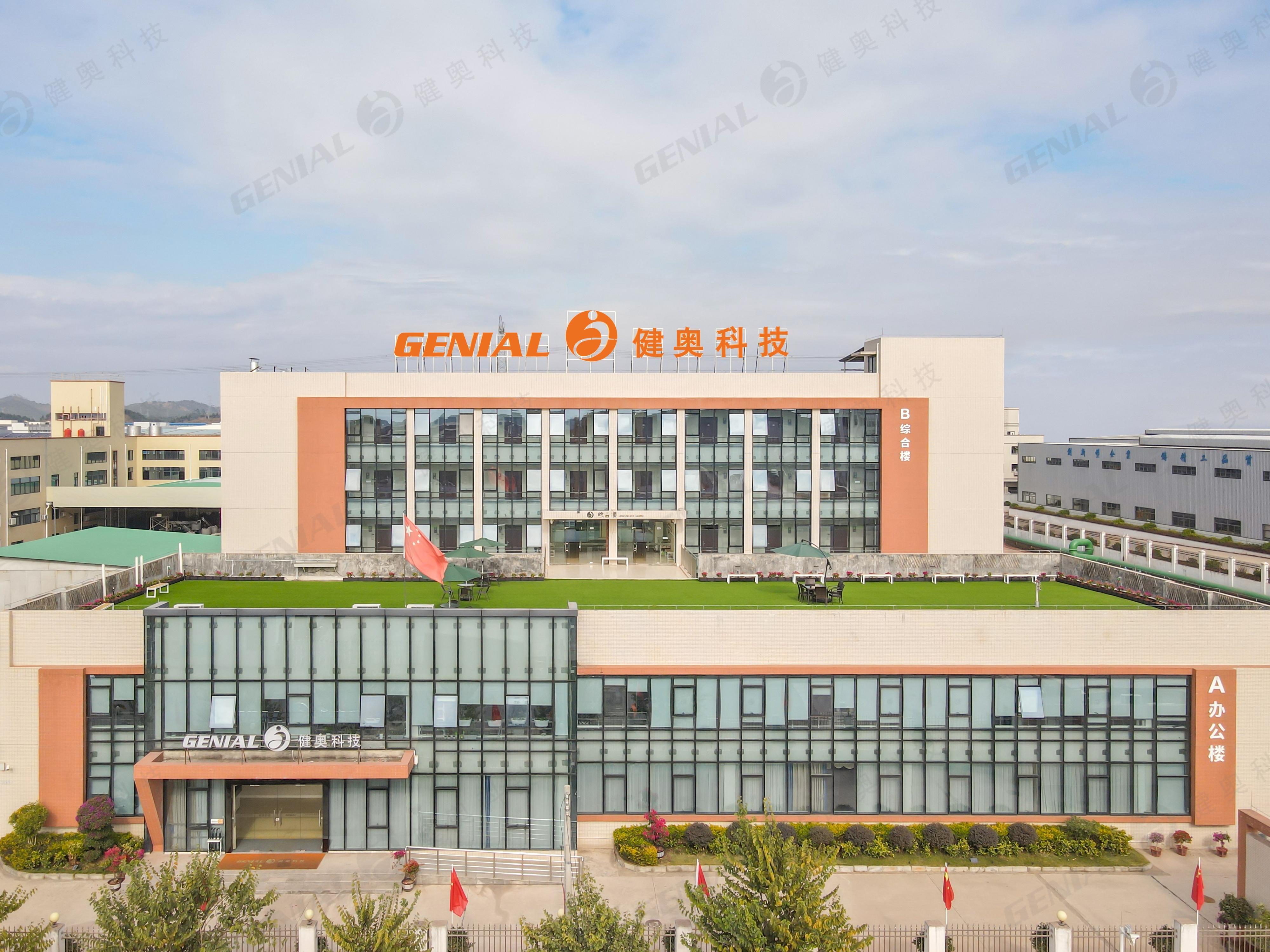
This guide maps device categories to three project settings — community clinics, health and wellness centers, and chronic disease management programs — and then positions three upper-arm digital blood pressure monitors from Genial Technology: GT-732, GT-732M and GT-702BM. Genial Technology (Guangdong Genial Technology Co., Ltd.), established in 2001, manufactures and supplies these categories and lists thermometers, blood pressure monitors, oximeters, nebulizers, ventilators and related devices in its portfolio.
The short answer: use an upper-arm blood pressure monitor as the anchor device, add a digital thermometer for acute triage, a finger pulse oximeter for respiratory triage, a mesh nebulizer where treatment support is in scope, and a ventilator only where a supervised sleep or respiratory therapy pathway exists. Then select the monitor configuration by documented cuff range, pressure range and materials — not by price alone.
The planning problem: many users, one shared device pool
A household device serves one or two people whose arm size is known. A program device pool serves a population whose arm circumference, technique and health literacy vary, and whose readings must stay comparable month over month. Three practical problems follow, and each one narrows the device list.
Fit. An upper-arm cuff that is outside the participant's arm range produces a reading the program cannot defend. The product data for this blood pressure family shows how wide that gap actually is: GT-702, GT-702B and GT-702C are specified at 22~32 cm arm circumference, while GT-732M, GT-702V, GT-702L and GT-702CM are specified at 22~42 cm. A program that stocks only the narrower configuration is, in effect, deciding that a share of its enrolled population falls outside the range the device was designed for.
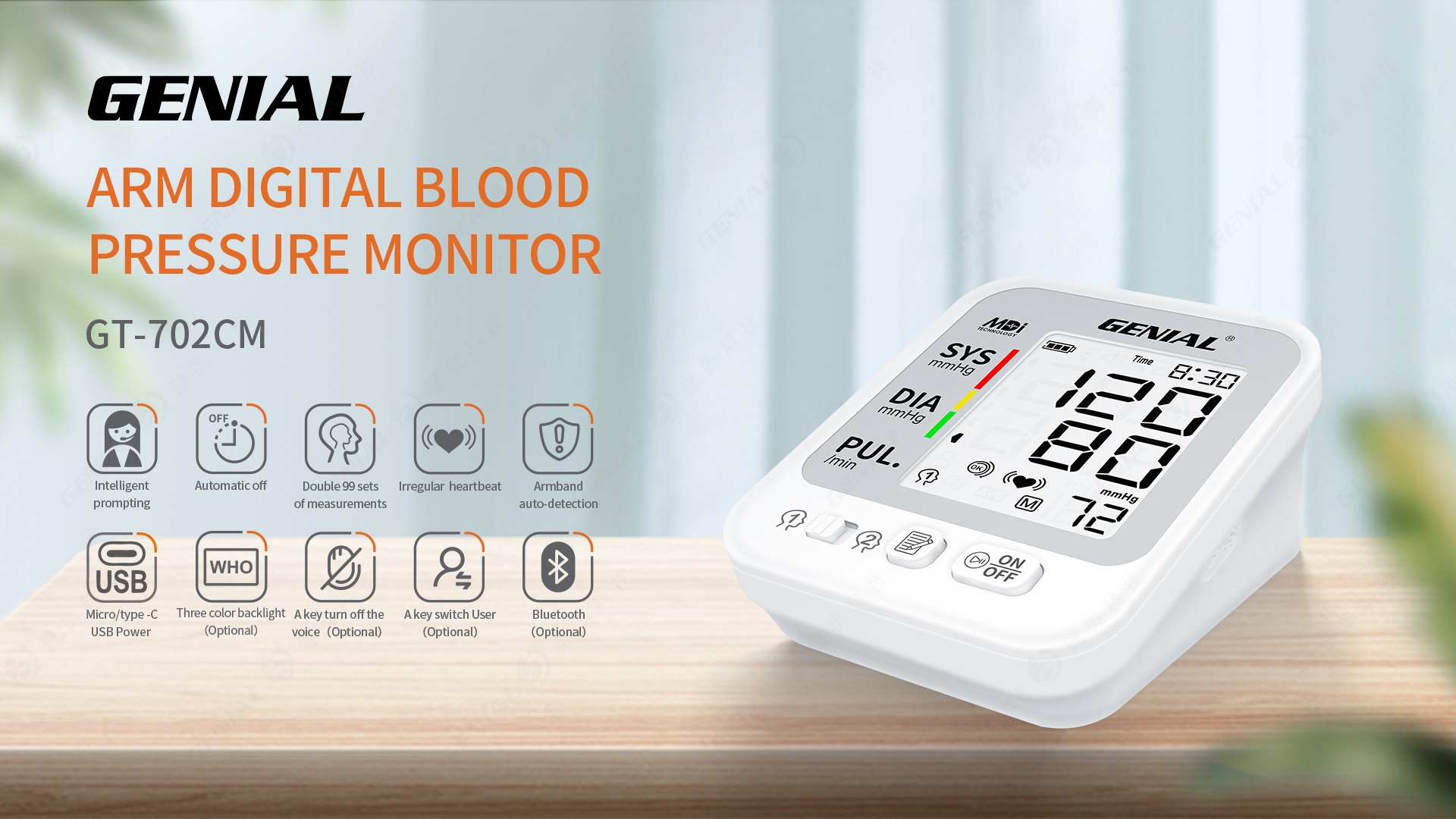
Staffing. Program staff rarely have clinical measurement training. The blood pressure application data for this family describes automatic pressurization, one-button operation, battery or USB power and automatic shut-down — the operating model that lets a screening station run without a specialist present. Optional voice broadcast and app connection matter where participants cannot easily read a small display.
Records. A reading that stays on a device screen or in a paper notebook cannot support a trend conversation. The company's cloud health management platform is described as collecting vital-sign data via Bluetooth, storing history in the cloud, generating daily, weekly and monthly trend reports, pushing threshold alerts and supporting family multi-member profiles — and, for institutions, one-to-many batch monitoring through a Bluetooth gateway.
The map that follows is built on exactly these three constraints: who gets measured, who does the measuring, and where the record goes.
Industry context: why upper-arm monitors still anchor these programs
The market context supplied for this category estimates the home medical equipment market at USD 54.35 billion in 2026, with North America holding approximately 40.35% of that market in 2025 (Mordor Intelligence industry report, published September 2026). Within blood pressure monitoring specifically, upper-arm monitors held 59.10% of segment share in 2025, while wrist-based and wearable formats were reported as growing at a 12.07% CAGR over the same research period (same source). Read together, those figures describe a market where upper-arm devices remain the default configuration for institutional and home programs even while wearable formats expand.
For a program planner, that has a practical consequence. A pool of upper-arm devices with documented cuff ranges is easier to standardize, easier to train on, and easier to explain in a funding application than a mixed fleet of form factors. Wrist and wearable formats answer different questions — continuous monitoring, comfort, remote follow-up — and are better treated as additions to a program than as replacements for the measurement station.
A standards layer sits behind all of this. UL describes IEC 60601-1-11 as the collateral standard used together with IEC 60601-1 for home healthcare equipment, addressing risks in uncontrolled home environments with untrained users. ISO 80601-2-56:2017 covers clinical thermometers, cited with a ±0.1 °C accuracy requirement, and ISO 80601-2-61 governs pulse oximeters, where SpO2 accuracy is conventionally expressed as Arms over a stated saturation range. General usage guidance in the peer-reviewed literature also recommends calibrating home monitoring equipment at frequent intervals and operating it between 16 and 40 °C with humidity below 85%.
One documentation detail is worth flagging early, because it affects room planning. Genial's application data for its blood pressure monitors specifies an operating environment of 5–40 °C and 15–85% RH, non-condensing, while the general guidance article recommends 16–40 °C with humidity below 85%. Where the two figures differ, the instruction manual supplied with the specific device governs that device; the general figure is a planning reference for the room.
The device map: five categories, five distinct jobs
Five categories cover most community chronic disease workflows, and each one has a defined job. The mapping below uses the application and product data supplied for the Genial portfolio.
- Upper-arm digital blood pressure monitor — the anchor. The blood pressure application data lists measurement of systolic pressure, diastolic pressure and pulse rate, WHO blood-pressure classification indication, irregular-heartbeat detection and dual-user memory storage, with automatic pressurization, one-button operation, battery or USB power, optional voice broadcast and app connection, and automatic shut-down. Accessories listed are cuff, batteries, power adapter, storage bag and app support. That combination is what a follow-up room needs: a repeatable reading plus a stored reference point.
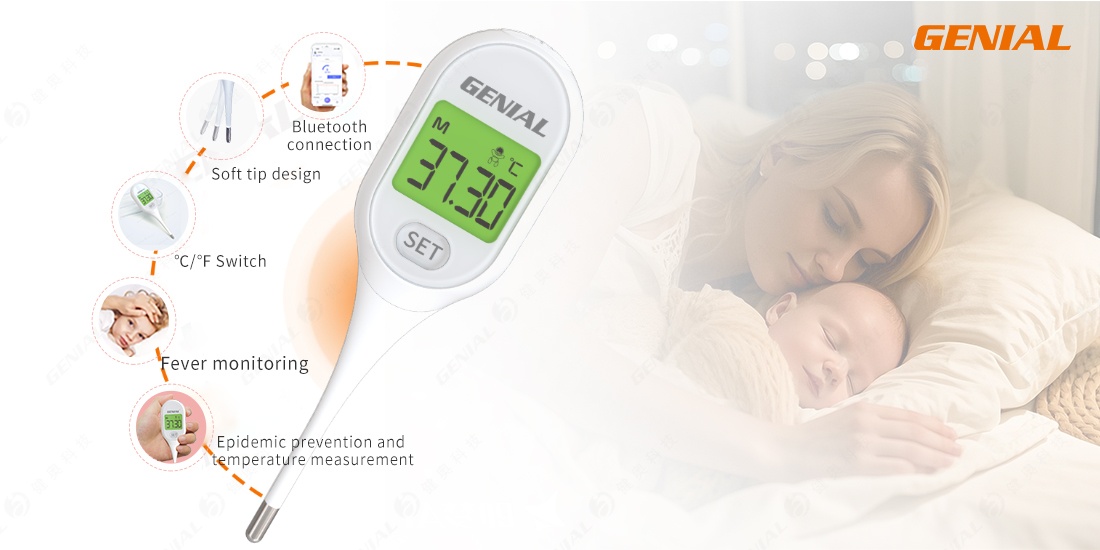
- Digital thermometer — acute triage and safety net. Contact models such as T14 and T11/T12 measure 32.0–42.9 °C at ±0.1 °C with IPX5 water resistance, and the flexible-tip T28 is specified at ±0.1 to ±0.3 °C depending on temperature range. Non-contact infrared models including T90/T92, T94, T81/T80 and T86/T87 measure in eight seconds or less with forehead and ear modes, an error within 35–42 °C of ≤0.2 °C, and storage of 32 record sets.
- Finger pulse oximeter — respiratory triage. The oximeter application data specifies SpO2 measurement across 35%–100% and pulse rate across 30–250 bpm, using photoelectric transmission measurement with an OLED display and automatic shut-down, and lists respiratory disease management, elderly care, sports health and home healthcare among its project types.
- Mesh nebulizer — treatment support. The nebulizer data specifies particle size ≤5 μm and an atomization rate ≥0.50 ml/min using 106 kHz ultrasonic mesh technology, powered by battery, 3.7V lithium battery or Micro USB, supplied with adult mask, child mask and mouthpiece.
- Ventilator / sleep apnea therapy device — supervised pathway only. The ventilator data specifies CPAP/APAP automatic pressure adjustment across 4–25 cmH2O, heated humidification, exhalation pressure relief, a fan system rated ≤35 dB and AC 100–240 V input.
The data layer is a category in its own right. Where a program wants trends rather than single readings, the cloud platform described above needs Bluetooth 5.0 connectivity, a compatible Android or iOS device, and — for institutional batch monitoring — a Bluetooth gateway. Programs that cannot guarantee connectivity can still run every device in offline local mode, with results shown on the device screen and recorded manually.
GT-732, GT-732M and GT-702BM: three configurations, three project roles
All three are upper-arm digital blood pressure monitors in the same family, so the choice is not about device category. It is about documented configuration and the role the model plays in a project: pooled clinical measurement, standard baseline measurement, or household distribution.
GT-732M: the documented chronic-disease configuration
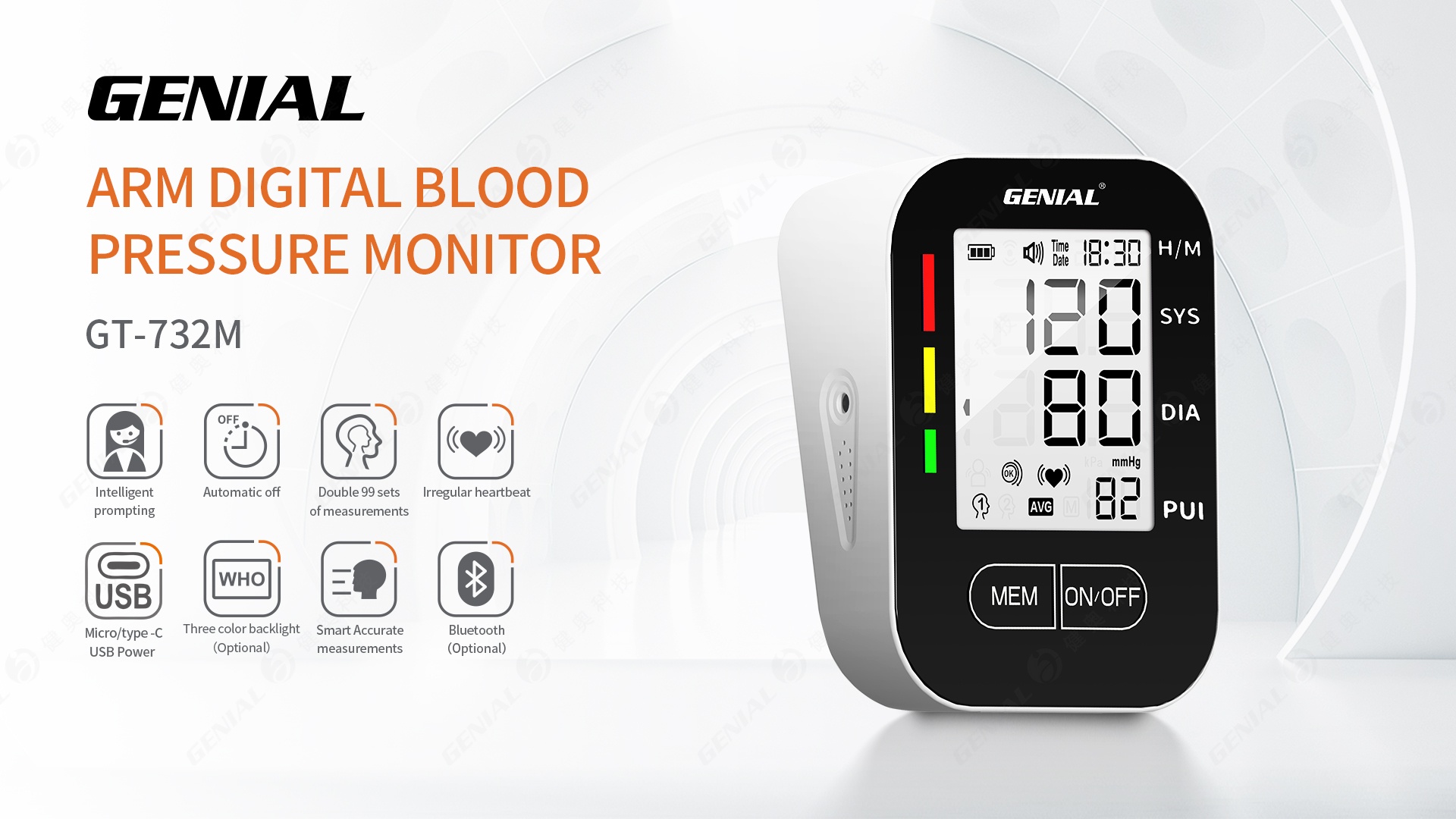
GT-732M is the model in this group with the most complete specification in the supplied product data. It is documented with a pressure range of 0~290 mmHg, an arm circumference range of 22~42 cm, a pulse error of ≤±5%, dimensions of 136×103×54 mm and a net weight of 239 g ±15 g without battery, built in ABS with an eco-friendly TPU air bag. Its listed application industries are chronic disease management institutes, community medical centers and insurance promotional gifts.
Three of those specifications deserve interpretation rather than repetition. The 22~42 cm cuff range is the widest documented in this family and is the reason the model suits a pooled device serving mixed arm sizes. The 0~290 mmHg pressure range is the measurement envelope the device is designed to cover. The ≤±5% figure is a pulse error tolerance, not a blood pressure accuracy claim; Genial's blood pressure product page separately states that measured pressure should fall within 3 mmHg of analyzer data, and that internal acceptance criterion is the one a technical reviewer should ask about when accuracy is discussed.
The material choice is a program decision as much as an engineering one. An ABS housing with an eco-friendly TPU air bag is a specification a procurement team can cite, but it does not by itself establish how many inflation cycles the bladder will survive in a busy clinic. Ask the supplier for the cleaning method and the cuff replacement interval in writing before the device enters a shared pool.
GT-732: the baseline unit in the same family
The portfolio lists GT-732 as an upper-arm digital blood pressure monitor and includes it in the same application block that covers community chronic disease management projects, home healthcare procurement, pharmacy retail, elderly-care support and insurance healthcare gift projects. Model-level parameters for GT-732 were not part of the product data used for this guide, so this guide does not restate them.
That gap is a planning instruction, not a reason to skip the model. Because the family contains both 22~32 cm and 22~42 cm configurations, the safe way to place GT-732 in a tender is to confirm its cuff range, pressure range and material from the current datasheet first, then decide whether it serves the standard-arm segment of the population or the full range. Programs that mix models should document which participant groups are measured on which device, so that a trend line is never built from two different cuff configurations.
GT-702BM: home health monitoring and wholesale distribution
GT-702BM plays a different role. It is positioned for home health monitoring and for wholesale distribution — the model a distributor stocks for household use rather than the unit a clinic keeps on a shared table. It also appears among the models listed in the family's community chronic disease management, home healthcare, pharmacy retail and insurance gift application block, which makes it a practical bridge SKU between a distribution catalogue and a care-programme order.
The distinction matters because the duty cycle differs. A pooled clinic device is inflated many times a day by many hands and needs the widest cuff the population requires; a distribution SKU needs a stable, well-documented household configuration, consistent packaging and the channel documentation a distributor must pass downstream. As with GT-732, confirm model-level specification from the current datasheet before printing it into a catalogue or a tender response.
Building the device map: six steps
- Define the measurement job and the population. Decide which conditions the program follows — hypertension, chronic respiratory disease, sleep-disordered breathing — and how often each participant is measured. This determines the device count far more reliably than the enrolled headcount, because a monthly follow-up room and a weekly screening station consume the same device very differently.
- Set the cuff and pressure envelope. Compare the documented arm circumference ranges against the actual population. Where a single wide-range model such as GT-732M, GT-702V, GT-702L or GT-702CM at 22~42 cm covers the group, one model simplifies both training and spare-cuff logistics. Where the population is uniformly within 22~32 cm, a narrower configuration may be sufficient.
- Assign each station a model role. Use GT-732M where pooled chronic disease measurement needs the widest documented cuff; use GT-732 as the baseline unit once its datasheet is confirmed; use GT-702BM where the deliverable is a household device that moves through a distribution channel.
- Add complementary categories with an escalation rule. A thermometer answers an acute question, an oximeter answers a respiratory question, a nebulizer supports treatment and a ventilator belongs to a supervised therapy pathway. Write down what staff do when a reading crosses a threshold — refer, retest, or record and continue — before the devices arrive.
- Decide the data layer. Offline local mode requires no infrastructure and no phone. Bluetooth cloud mode adds trend reports, threshold alerts on the app, sharing with family members and attending physicians, and PDF export. Institutional batch monitoring needs a Bluetooth gateway. Choose deliberately; do not assume connectivity.
- Verify documents, samples and lead times against the rollout calendar. Compliance paperwork, a physical sample round and production lead time are three separate schedules, and the programme launch date is usually the shortest of the three.
Three scenario blueprints
Community clinic: hypertension follow-up room
The clinic needs one repeatable measurement and a record that survives staff changes. A pooled GT-732M covers the 22~42 cm arm range, the family-level functions supply WHO blood-pressure classification indication and irregular-heartbeat detection, and dual-user memory gives a stored reference point even before any app is configured. Add a contact digital thermometer for walk-in fever triage and a finger pulse oximeter for participants presenting with respiratory symptoms. Keep the escalation rule visible on the wall next to the device.
Health and wellness center: screening station
A wellness center screens more people, less often, and often at an entrance rather than in a room. Non-contact infrared thermometers measuring in eight seconds or less, with forehead and ear modes and ≤0.2 °C error within 35–42 °C, suit that flow, and their 32-record storage keeps a short history without a network. Pair the thermometer with an upper-arm monitor and an oximeter. One boundary should be stated plainly to participants: wellness screening identifies people who should seek a clinical assessment; it does not diagnose.
Chronic disease management and distribution program
Where the program follows participants at home, the device mix shifts. GT-702BM serves the household distribution role, GT-732M stays in the clinic as the reference device that generates comparable readings, and a wearable Bluetooth thermometer supports continuous temperature monitoring with app and cloud synchronisation for remote follow-up. The program’s job is to keep the home device and the clinic device on the same measurement protocol.
Model comparison: what is documented, and what is not
| Model | Documented configuration | Pressure range | Arm circumference | Pulse error | Documented project fit |
|---|---|---|---|---|---|
| GT-732M | ABS housing, eco-friendly TPU air bag; 136×103×54 mm; 239 g ±15 g without battery | 0~290 mmHg | 22~42 cm | ≤±5% | Chronic disease management institutes, community medical centers, insurance promotional gifts |
| GT-732 | Upper-arm digital blood pressure monitor; model-level parameters not included in the data used for this guide | — | — | — | Listed in the family application block for community chronic disease management, home healthcare, pharmacy retail, elderly care and insurance gift projects |
| GT-702BM | Positioned for home health monitoring and wholesale distribution; model-level parameters not included in the data used for this guide | — | — | — | Household monitoring and distribution channel; also listed in the family application block |
| GT-702CM (reference) | ABS; 135×110×65 mm; 238 g ±15 g without battery | 0~290 mmHg | 22~42 cm | — | Chain pharmacy, OEM processing factory |
| GT-702V (reference) | ABS; 99 memory sets for 2 users; 119×93×43 mm; 180 g ±15 g without battery | 0~290 mmHg | 22~42 cm | — | Cross-border e-commerce, household medical supply |
A dash means the value is not stated in the product data used for this guide. It is not a statement that the feature is absent. Confirm every field against the current datasheet for the exact model before ordering or publishing a tender document.
Budget, sampling and lead-time planning
No prices are quoted in this guide because the supplied data contains none, and a made-up figure would be worse than no figure. What the data does show is the cost structure a program should model: the number of device categories per station, whether one wide-range cuff model covers the population or two models are required, whether memory and connectivity features are needed at every station, and how much packaging, labeling and registration support the project requires.
Order structure moves cost as much as unit choice. In the OEM mode, minimum order quantities are listed as 2,000 units for blood pressure monitors, oximeters, nebulizers, infrared thermometers and wireless thermometers, 10,000 pieces for thermometers and 500 units for ventilators, with packaging, gift box, manual, logo and color customization available while core hardware and key functions stay unchanged. ODM work is listed at 5,000 units for product modification and 10,000 units for new mold development, with tooling cost refundable on large-volume projects. JDM projects start at 10,000 units for an initial mass-production order, with no strict MOQ on repeat orders.
Lead times differ by mode and should be planned separately from registration paperwork. OEM samples are listed at 3 days, small orders at 3–7 days and mass orders at 10–15 days. ODM minor modifications without new tooling run 7–15 days, while new mold development runs 45–50 days. JDM projects are listed at 45–60 days. Under OBM, in-stock products ship within 48 hours and replenishment orders take 5–7 days. Every mode includes a 12-month warranty against valid proof of purchase, plus certification documentation support and technical consultation.
Limits, risks and what to verify before signing
Three limits deserve to sit next to the specification table rather than in a footnote. First, model-level coverage is uneven: GT-732M carries a full specification in the supplied data, while GT-732 and GT-702BM do not, so any document that assigns them parameters must cite the current datasheet rather than an assumed family value. Second, certification statements are supplier-reported. Genial states ISO 13485, ISO 45001, ISO 14001, BSCI and GB/T 29490 system certifications and CE, NMPA, FDA, CB, FCC and RoHS product certifications, with registration completed in 29 countries; these claims should be re-verified against the certificate for the exact model and the exact market before purchase. Third, all of these devices support monitoring and screening; none of them replaces a clinical diagnosis, and a program that communicates otherwise creates risk for its participants and its staff.
Environmental and calibration questions belong in the same review. Confirm the operating range in the instruction manual against the room the program will actually use, and set a calibration and cuff-replacement schedule rather than assuming the device will stay in tolerance indefinitely.
FAQ
Which compliance documents should a program verify before ordering home medical devices?
For the blood pressure monitors described here, Genial states NMPA registration for the domestic market and export certifications covering FDA, CE, FCC, GCC, MDR, RoHS and IECEE CB; oximeters, thermometers, nebulizers and ventilators are listed with comparable export sets. Verify each certificate against the exact model and the exact destination market, check validity dates, and confirm the device is labeled for home use — IEC 60601-1-11 is the collateral standard that addresses home healthcare equipment risks with untrained users. Treat supplier certification statements as a screening input and re-verify them against the certificate itself.
Can one upper-arm monitor model serve an entire community program?
Only if its cuff range covers the enrolled population. GT-732M is documented at 22~42 cm arm circumference with a 0~290 mmHg pressure range, a pulse error of ≤±5% and an ABS housing with eco-friendly TPU air bag. Models documented at 22~32 cm, including GT-702, GT-702B and GT-702C, will not cover the same arms. Where the population includes larger arms, check the 22~42 cm configurations first — GT-732M, GT-702V, GT-702L and GT-702CM — and confirm each datasheet before committing a tender.
What drives the budget of a community device program?
The main cost variables are the number of device categories per station, whether one wide-range cuff model replaces two narrower models, whether memory and Bluetooth features are needed everywhere or only at the reference station, how much packaging, labeling and registration support the project requires, and the order structure. For reference, OEM minimums are listed at 2,000 units for blood pressure monitors, ODM modification at 5,000 units and new mold development at 10,000 units. No unit prices are quoted in this guide; request a quotation per configuration.
How should a program validate a sample before rollout?
Test the device against the people it will actually serve rather than against a specification sheet alone. Check cuff fit across the real arm range, run repeated measurements on the same participants to see whether readings stay consistent, confirm that pulse and pressure values fall inside the documented tolerances, and verify that staff can complete a measurement and record it without supervision. OEM sample lead time is listed at 3 days, which leaves room for a proper validation round before the mass order is placed.
What lead times should a rollout plan assume?
Plan by production mode rather than by average. OEM samples are listed at 3 days, small orders at 3–7 days and mass orders at 10–15 days. ODM minor modifications take 7–15 days, new mold development takes 45–50 days, and JDM projects are listed at 45–60 days. OBM in-stock items ship within 48 hours with 5–7 days for replenishment. Add registration and documentation time on top, and build the launch date from the slowest of those tracks. If a sample round or a configuration quotation would help the planning, that request can be raised with the supplier before the tender closes.
Conclusion
A community chronic disease program does not need the largest device list; it needs a defensible map. The upper-arm blood pressure monitor anchors the workflow, the thermometer and oximeter handle triage, the nebulizer and ventilator serve defined therapy pathways, and the data layer decides whether a reading becomes a trend. Within the monitor family, GT-732M carries the widest documented cuff range at 22~42 cm together with a 0~290 mmHg pressure range, an ABS housing and an eco-friendly TPU air bag, which is why it fits pooled chronic disease and community medical center use; GT-732 serves as the baseline unit once its datasheet is confirmed; and GT-702BM fits household monitoring and wholesale distribution. Confirm the specification, the certificate and the lead time for the exact model before the program signs, and the device map will still hold in year two.
For the full device portfolio, specifications and certification overview, download the Genial Technology English product brochure (PDF).
Have Questions or Need More Details?
Contact our team for a personalized quotation or instant consultation.
Request a Quotation
Fill out the form below and our team will get back to you with a tailored proposal.
WhatsApp Direct Chat
Prefer to chat in real-time? Message us on WhatsApp for instant assistance & quick answers.
- Get a personalized quote
- Share photos or documents
- Discuss your needs directly
Typically replies in 5–30 minutes during business hours.