
GT-732 vs. GT-732M: Choosing the Right Upper Arm Digital Blood Pressure Monitor for OEM
Short answer: the GT-732 and the GT-732M are both Upper Arm Digital Blood Pressure Monitors built on the same 136×103×54 mm ABS housing with the same 0–290 mmHg pressure measuring range. They separate on the parts that decide your channel. The GT-732 uses a PVC air bag with a nylon binding strap and fits arm circumferences of 22–32 cm at 291 g ±15 g (without battery). The GT-732M uses an eco-friendly TPU air bag, fits 22–42 cm, and weighs 239 g ±15 g (without battery). If your programme serves a broad adult population — chronic disease management, community medical centres, insurance gift programmes — the wider GT-732M cuff usually decides it. If you sell into community clinics, health and wellness centres, e-commerce or a customized OEM gift line where a 22–32 cm cuff matches the buyer profile, the GT-732 is the more direct fit.
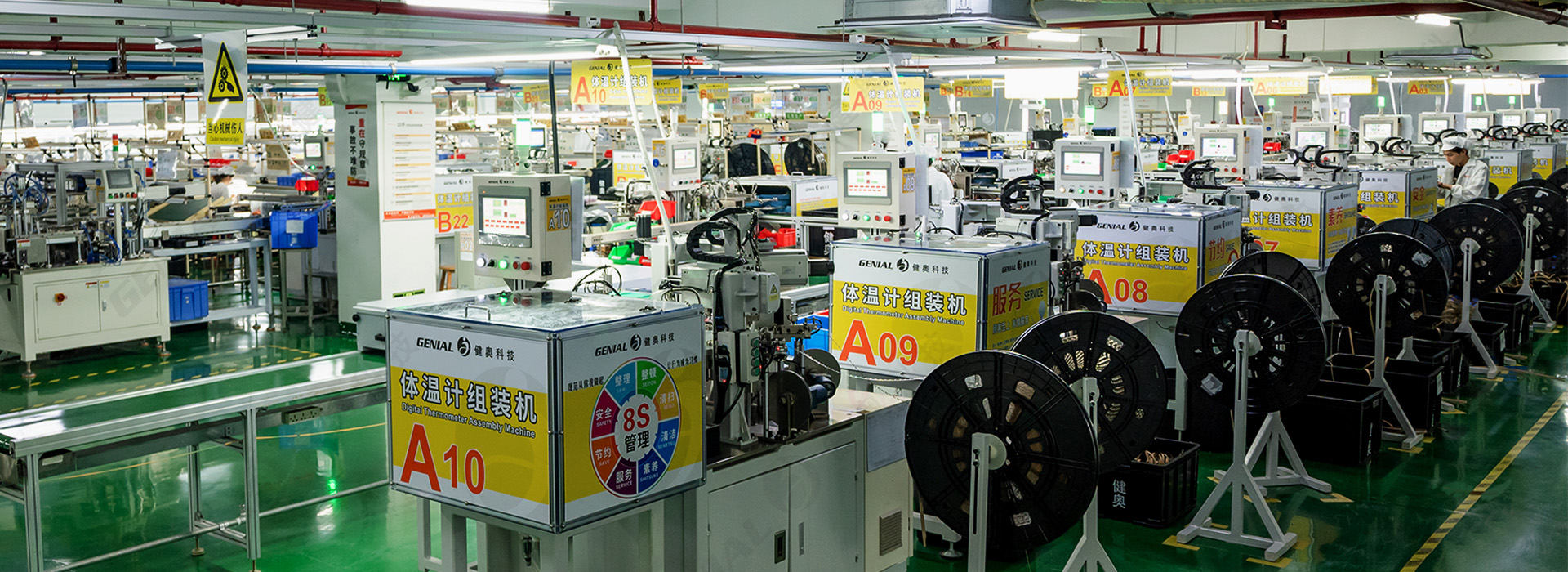
This guide is written for importers, distributors, pharmacy chain buyers and OEM sourcing managers who have to justify a model choice internally, not just fill a line on a purchase order. GENIAL is Guangdong Genial Technology Co., Ltd., a medical device manufacturer established in 2001 in Guangdong, China, operating a 45,000 m² production base with 251 employees and an annual output of 15,000,000 units. The company exports approximately 80% of its production and has completed product and trademark registration in 29 countries, with products sold to 117 countries and regions worldwide.
The problem: two models, one quotation line, two different install bases
On a specification sheet, the GT-732 and the GT-732M can look interchangeable. Same product type, same housing dimensions, same pressure ceiling, and a pulse accuracy figure that reads as ±5% on both. That similarity is exactly what creates sourcing risk. Buyers who compare only the headline numbers frequently standardise on one model across every channel, then discover after launch that a meaningful share of their target users cannot be measured comfortably.
The practical failure mode is the cuff. An upper arm monitor is only as useful as the arm it can wrap. A device supplied with a 22–32 cm cuff will physically close on a 34 cm upper arm only with difficulty, which affects comfort, repeat usage and, in community screening settings, the reliability of the reading routine. The GT-732M extends that range to 42 cm and, at 239 g ±15 g without battery, is approximately 52 g lighter than the GT-732 at 291 g ±15 g. That weight difference is small per unit and material per container load.
A second failure mode is material positioning. The GT-732’s air bag is PVC with a nylon binding strap. The GT-732M’s air bag is eco-friendly TPU. If your retail listing, tender document or insurance programme states an environmental or material preference, that single line of the bill of materials becomes a decision criterion rather than a detail.
Finally, there is the channel-fit problem. GENIAL positions the GT-732 for community clinics, health and wellness centres, e-commerce and customized OEM gift programmes. It positions the GT-732M for chronic disease management institutes, community medical centres and insurance promotional gifts. Those are not cosmetic labels; they describe the user population, purchase quantity and packaging expectations each model was designed to serve.
Industry background: why upper-arm accuracy keeps winning procurement
Upper-arm monitors remain the dominant format in blood pressure monitoring. Market research published in 2026 estimates that upper-arm monitors controlled 59.10% of the blood pressure monitoring market share in 2025, with wrist-based and wearable formats growing at a 12.07% CAGR from a smaller base. For OEM buyers, that means the category you are sourcing into is stable, established and heavily standardised — and the competitive difference between suppliers sits in specification detail and documentation rather than in category novelty.
The wider home medical equipment market, as estimated in the same 2026 research, was valued at USD 54.35 billion in 2026, with North America holding approximately 40.35% of the market in 2025. Demand is therefore concentrated in markets where regulatory documentation is a hard gate rather than a marketing claim.
On the technical side, home-use medical electrical equipment sits under a specific collateral standard. UL guidance identifies IEC 60601-1-11 as the collateral standard used alongside IEC 60601-1 for the certification of home healthcare equipment, and it addresses the risks of an uncontrolled home environment with untrained users. Clinical and usage guidance published in PubMed Central adds a practical operating frame: home health monitoring equipment should be calibrated at frequent intervals and operated within an ambient temperature of 16 to 40°C with humidity below 85%. These are the conditions your end users will actually create, and they are the conditions a supplier’s testing regime should be designed around.
GT-732 and GT-732M at specification level
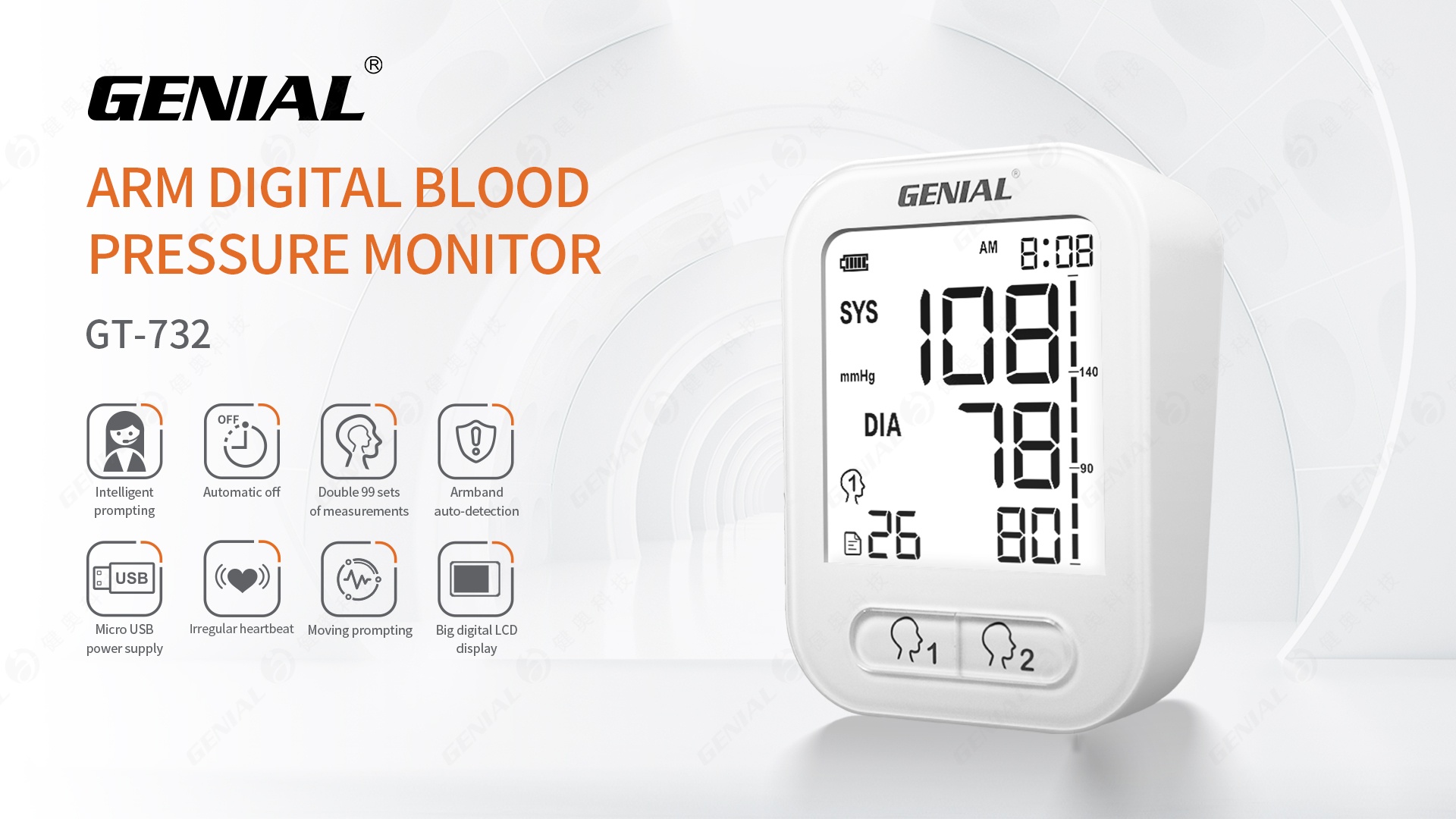
GT-732
- Product type: Upper Arm Digital Blood Pressure Monitor.
- Construction: ABS housing, PVC air bag, nylon binding strap.
- Pressure measuring range: 0–290 mmHg.
- Pulse tolerance: ±5%.
- Arm circumference: 22–32 cm.
- Dimensions: 136×103×54 mm.
- Net weight: 291 g ±15 g (without battery).
- Manufacturer-positioned applications: community clinic, health and wellness centre, e-commerce, customized OEM gift.
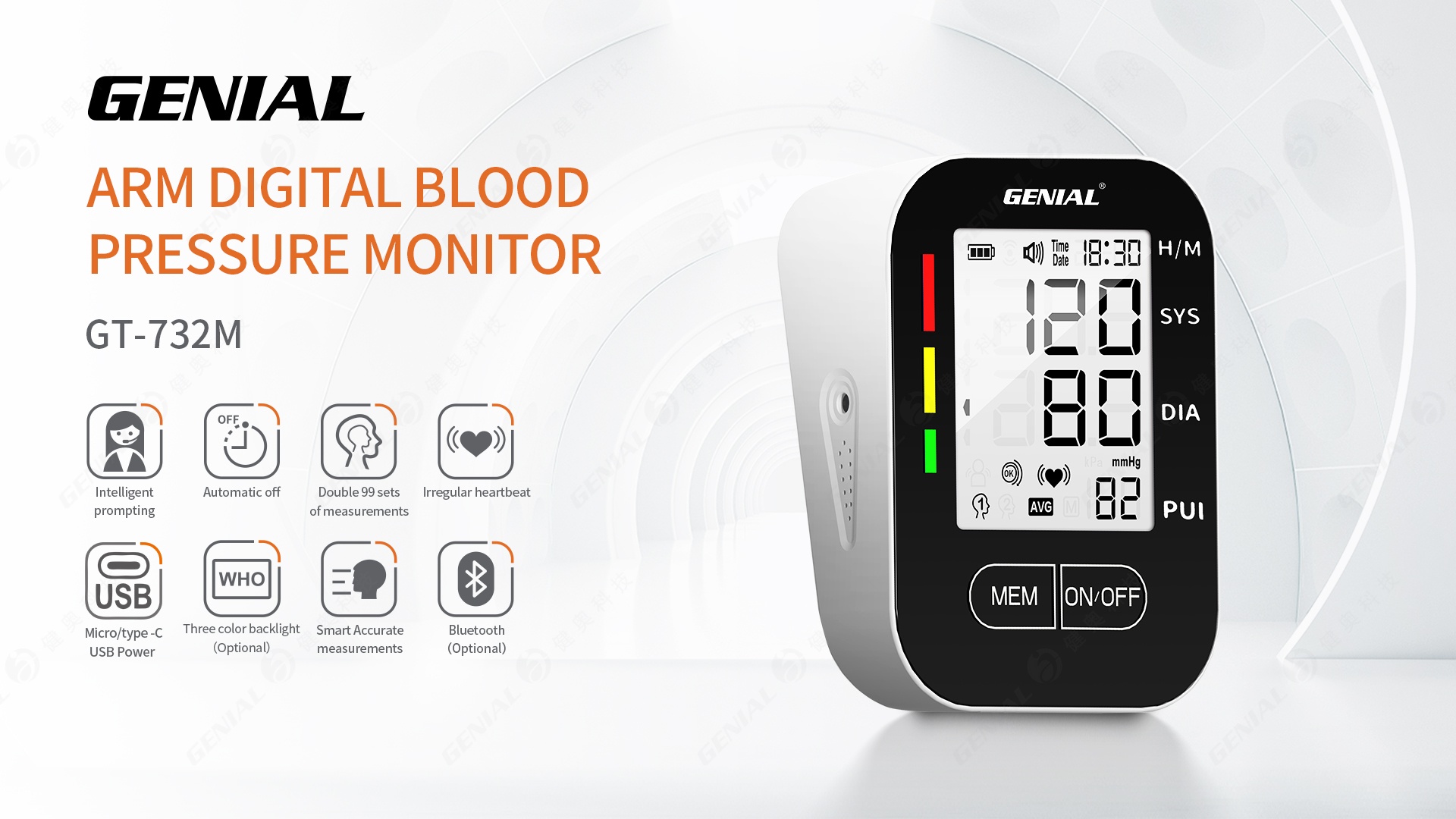
GT-732M
- Product type: Upper Arm Digital Blood Pressure Monitor.
- Construction: ABS housing, eco-friendly TPU air bag.
- Pressure measuring range: 0–290 mmHg.
- Pulse error: ≤±5%.
- Arm circumference: 22–42 cm.
- Dimensions: 136×103×54 mm.
- Net weight: 239 g ±15 g (without battery).
- Manufacturer-positioned applications: chronic disease management institute, community medical centre, insurance promotional gift.
The entire functional difference between the two models resolves into three variables: cuff coverage (22–32 cm versus 22–42 cm), air bag material (PVC versus eco-friendly TPU), and unit mass (291 g versus 239 g without battery). Everything else — housing, footprint, pressure range, pulse accuracy class — is common to both.
How GENIAL states its blood pressure monitor accuracy testing
GENIAL’s blood pressure monitor product page states that each blood pressure monitor is calibrated and tested, and that the measured pressure on the monitor should be within 3 mmHg of analyzer data, with a deviation of less than 0.4 kPa. Read as a buyer, that is an internal acceptance criterion you can write directly into a purchase specification: it defines what a unit must demonstrate before it leaves the line, and it gives your incoming inspection team a reference point when you verify a delivery independently.
The same page set indicates that digital thermometers in the range are checked with thermostatic water bath testing for accuracy — a useful signal that the company runs device-specific test methods rather than a single generic inspection step across all product families.
Certification coverage: what applies to arm-type blood pressure monitors
Compliance is the constraint most likely to eliminate a model after a commercial decision has already been made, so it is worth confirming before the quote stage.
- EU: CE certificate CN25/00007953, SRN CN-MF-000021465, issued by SGS Belgium NV (Notified Body No. 1639) under MDR (EU) 2017/745 Annex IX Chapter I & III and EN ISO 13485:2016. Validity: 25 November 2025 to 25 November 2030. The certificate scope covers the arm-type Digital Blood Pressure Monitor family.
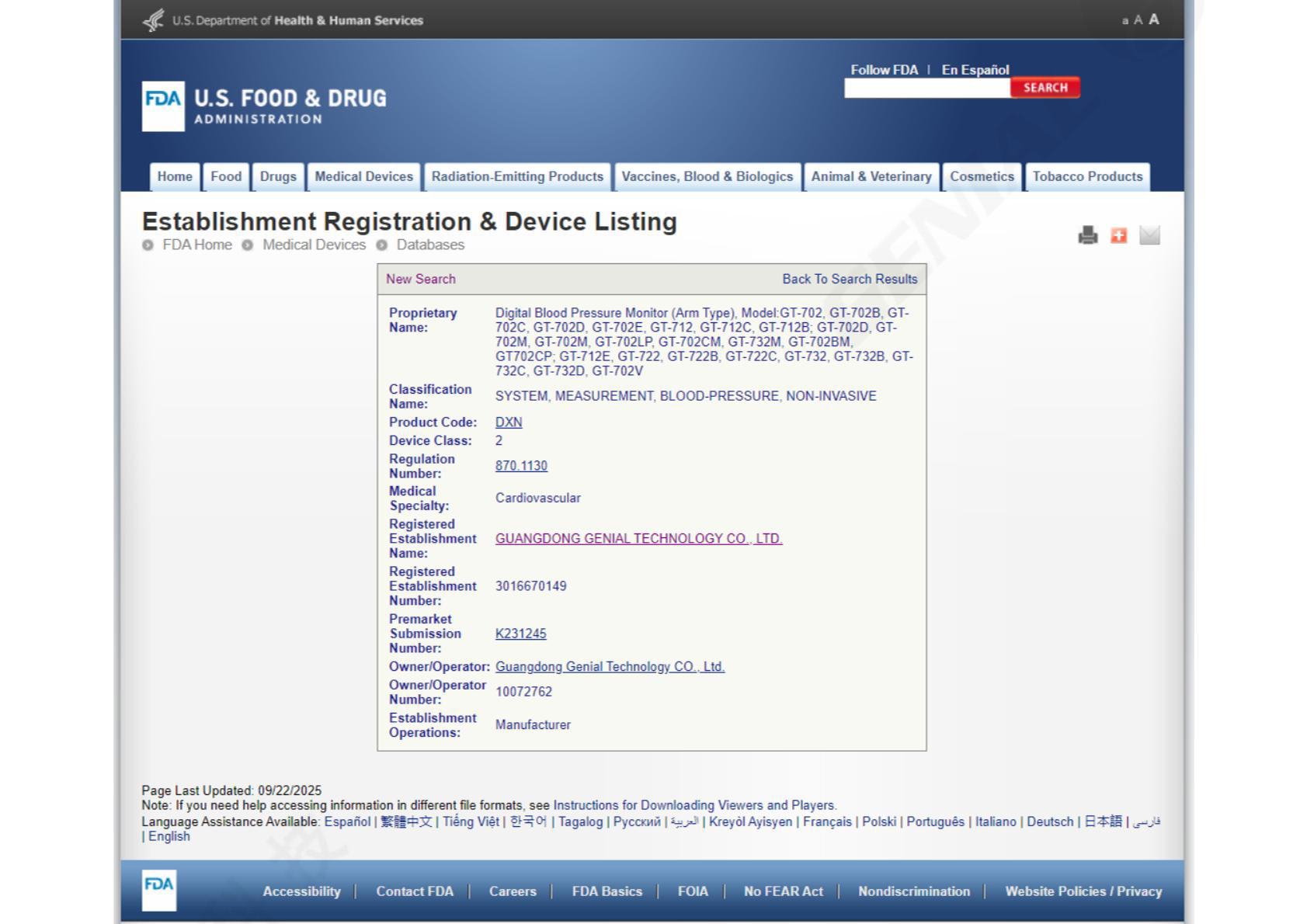
- United States: FDA 510(k) Premarket Notification K231245 for Digital Blood Pressure Monitor (Arm Type), covering the arm-type model series that includes the GT-732 and GT-732M group. A separate 510(k), K231250, covers wrist-type models such as GT-701 and GT-701C.
- Japan: Foreign Medical Device Manufacturer registration number BG10501496, issued by MHLW under Article 23-2-4 of the PMD Act. Validity: 19 November 2024 to 18 November 2029. The registration covers electronic upper arm blood pressure monitors, including the GT-732 and GT-732M.
- Russia: Roszdravnadzor certification No. № 1241/1-3 140/2-25 under GOST R national medical device safety and performance standards, issued 12 January 2026, covering automatic electronic blood pressure monitors.
- Great Britain: MHRA registration number 0000037417, issued 10 February 2026, covering automatic electronic sphygmomanometers within a broader home monitoring scope.
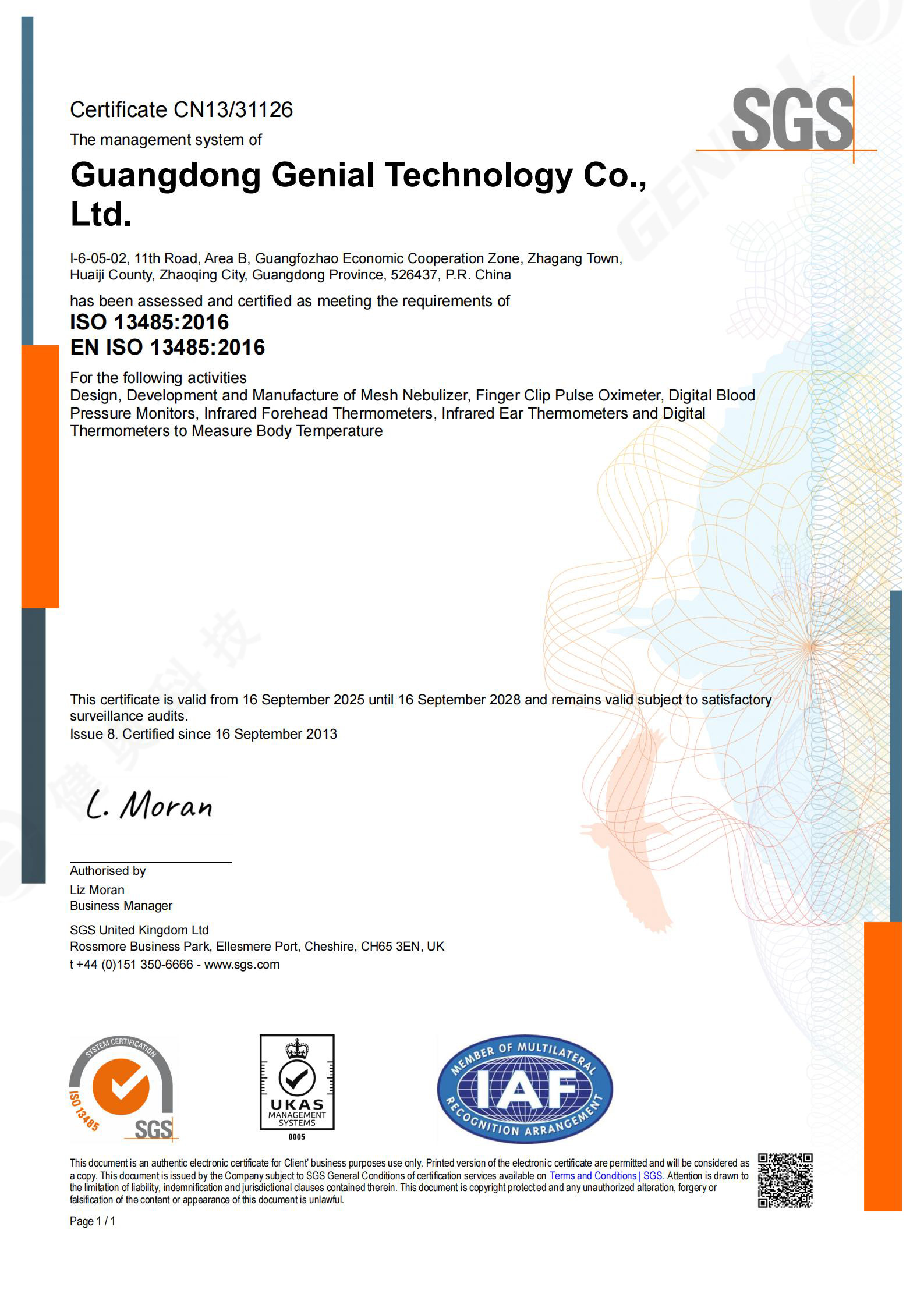
- Quality system: ISO 13485:2016 certificate CN13/31126 issued by SGS United Kingdom Ltd, valid 16 September 2025 to 16 September 2028, covering design, development and manufacture of digital blood pressure monitors alongside thermometers, oximeters and nebulizers.
- Additional system and social compliance: ISO 45001:2018 (certificate 02821S10111R1M, valid to 14 March 2027), ISO 14001:2015 (certificate 02821E10125R1M, valid to 14 March 2027), GB/T 29490 intellectual property management certification (18123IP0672R2M) and amfori BSCI social compliance with an overall rating of B (Monitoring ID 25-0372553, amfori ID 156-037830-000), valid to 6 February 2028.
Procurement note: certification scope statements are model-specific and can be amended over their validity period. Before a purchase order is issued, ask the supplier for the current certificate annex and confirm that the exact model number you are buying appears within the listed scope for each destination market.
Step by step: how to decide between the GT-732 and the GT-732M for an OEM order
Step 1 — Define the end-user population before the model
Start with the arm circumference range your programme has to serve, not with the model number. If the channel reaches a general adult population, including users with larger upper arms, a 22–42 cm cuff removes the objection before it appears in reviews. If the programme is defined by a narrower user group with a smaller average arm circumference, the 22–32 cm GT-732 cuff is sufficient and keeps the specification simple.
Step 2 — Match the air bag material to the channel story
The GT-732’s PVC air bag with nylon binding strap is the established, conventional build. The GT-732M’s eco-friendly TPU air bag supports a material narrative that suits tender documents, corporate wellness programmes and insurance schemes where environmental criteria appear in the specification. If no such criterion exists in your market, this difference is neutral rather than decisive.
Step 3 — Convert unit weight into logistics maths
Compare 291 g ±15 g against 239 g ±15 g per unit, without battery, across your order quantity and your chosen shipping mode. The calculation is straightforward and worth running before negotiation, because a lighter unit changes carton weights and container utilisation at volume.
Step 4 — Confirm regulatory coverage per destination market
Map each destination against the certificate list above. Where a market requires local registration rather than acceptance of an international certificate, confirm the registration route with the supplier’s registration team early, because registration lead time sits outside manufacturing lead time.
Step 5 — Fix the acceptance criteria in writing
Write the pressure acceptance criterion into the specification: measured pressure within 3 mmHg of analyzer data. Add the operating envelope your market expects devices to be used in — guidance for home monitoring equipment references an ambient range of 16 to 40°C and humidity below 85% — and require that calibration and functional verification are performed on finished units, not merely on sub-assemblies.
Step 6 — Agree packaging, MOQ and delivery schedule
For blood pressure monitors, GENIAL’s OEM MOQ is 2,000 units, with samples produced in 3 days, small orders in 3–7 days and mass orders in 10–15 days. OEM customisation covers packaging, gift box, user manual, product logo printing, colour schemes and packaging specifications, while core hardware, PCB and key functions remain unchanged. If your project needs structural or firmware changes, the ODM route applies: minor modifications without new tooling carry a 5,000-unit MOQ and a 7–15 day lead time, while new mould development carries a 10,000-unit MOQ and a 45–50 day lead time. JDM projects, where the customer participates in product definition, start at 10,000 units for the initial mass-production order with a 45–60 day lead time.
Step 7 — Confirm the post-delivery position
GENIAL provides a free 12-month warranty on presentation of valid proof of purchase, together with certification documentation support and technical consultation. For distributor and tender work, confirm what documentation accompanies each shipment and how replacement units are handled, because the after-sales process is often what decides renewal.
Use cases: which model belongs in which programme
Community clinic and health and wellness centre programmes
The GT-732 is positioned for community clinics and health and wellness centres. In these settings, a stable, conventional cuff build matters more than maximum coverage, and the 22–32 cm range is consistent with routine adult screening where staff can redirect a user to an alternative device if needed.
E-commerce and customized OEM gift lines
Both the GT-732 and the GT-732M appear in GENIAL’s OEM gift positioning, but they point at different gifting logic. The GT-732 is positioned for e-commerce and customized OEM gift programmes where packaging and logo customisation carry the perceived value. The GT-732M is positioned for insurance promotional gifts, where a wider cuff range reduces the number of recipients who cannot use the gift they received — a practical consideration when a single device is distributed across an entire policy holder base.
Chronic disease management institutes
This is the GT-732M’s clearest home. Long-term hypertension monitoring requires the same device to be usable by a stable cohort of patients over months and years, and the eco-friendly TPU air bag is designed for that repeated-use context. The 22–42 cm cuff range also reduces the friction of fitting a fixed cuff to a clinically diverse patient group.
Community medical centres and public screening
Where a centre runs screening days with a broad walk-in population, cuff coverage becomes an operational constraint rather than a comfort preference. The GT-732M’s 22–42 cm range is the more forgiving specification in that scenario, and the lower unit mass is easier to manage when devices are moved between screening stations.
Comparison table
| Attribute | GT-732 | GT-732M | What it changes for an OEM buyer |
|---|---|---|---|
| Product type | Upper Arm Digital Blood Pressure Monitor | Upper Arm Digital Blood Pressure Monitor | Same category; both qualify for the same supplier registration routes |
| Housing material | ABS | ABS | No difference in the outer shell specification |
| Air bag / cuff construction | PVC air bag, nylon binding strap | Eco-friendly TPU air bag | Material claim differences for tenders, retail listings and sustainability criteria |
| Pressure measuring range | 0–290 mmHg | 0–290 mmHg | Identical measurement envelope |
| Pulse accuracy figure | Pulse tolerance ±5% | Pulse error ≤±5% | Same stated accuracy class |
| Arm circumference | 22–32 cm | 22–42 cm | The single largest determinant of end-user fit and of returns risk |
| Dimensions | 136×103×54 mm | 136×103×54 mm | Identical footprint; packaging and moulding assumptions carry across |
| Net weight (without battery) | 291 g ±15 g | 239 g ±15 g | Affects freight, carton weight and container utilisation at volume |
| Positioned applications | Community clinic, health and wellness centre, e-commerce, customized OEM gift | Chronic disease management institute, community medical centre, insurance promotional gift | Indicates the intended end-user population and channel logic |
| OEM MOQ (blood pressure monitors) | 2,000 units | 2,000 units | Identical entry quantity for OEM customisation |
| Sample lead time | 3 days | 3 days | Allows parallel sampling of both models before committing |
| Mass order lead time (OEM) | 10–15 days | 10–15 days | Same production window once documentation and packaging are approved |
| Warranty | 12 months with valid proof of purchase | 12 months with valid proof of purchase | Equivalent after-sales position |
Frequently asked questions
1. Are the GT-732 and the GT-732M covered by the same medical device certifications for export?
Both models sit inside GENIAL’s arm-type digital blood pressure monitor certification footprint rather than being certified individually. The CE MDR (EU) 2017/745 certificate CN25/00007953, with SRN CN-MF-000021465, was issued by SGS Belgium NV (Notified Body No. 1639) for the arm-type Digital Blood Pressure Monitor family and is valid from 25 November 2025 to 25 November 2030. In the United States, FDA 510(k) Premarket Notification K231245 covers Digital Blood Pressure Monitor (Arm Type) models in the GT-732 and GT-732M group. Japan registration BG10501496 was issued by MHLW under Article 23-2-4 of the PMD Act and runs from 19 November 2024 to 18 November 2029 for electronic upper arm blood pressure monitors. Manufacturing is covered by ISO 13485:2016 certificate CN13/31126 issued by SGS United Kingdom Ltd, valid from 16 September 2025 to 16 September 2028. Because scope annexes can be updated, confirm the current annex against your exact model number and destination market before ordering.
2. Can GENIAL manufacture both models at the same MOQ and output scale?
Yes. For OEM blood pressure monitors the minimum order quantity is 2,000 units for both models, and both share the same 10–15 day mass production window once order documentation and packaging are approved. Production capacity sits behind a 45,000 m² facility with 251 employees, an annual output of 15,000,000 units and a 29-engineer R&D team, with roughly 80% of output exported. The OEM quality control flow runs from order documentation and packaging approval through incoming material inspection and 100% production inspection to a final sampling inspection before shipment.
3. What drives the cost difference between the two models?
Price is quoted per project rather than published, so the reliable way to compare the two commercially is to request quotations built on identical assumptions: the same order quantity, the same packaging specification, the same Incoterms and the same destination. Once those are aligned, the differences to interrogate are the air bag material (PVC versus eco-friendly TPU), the unit mass of 291 g ±15 g against 239 g ±15 g without battery and its effect on freight and carton configuration, the cuff size itself, and the level of packaging or gift box customisation requested. If your project also requires structural or firmware changes, tooling cost moves into the picture under the ODM route, where new mould development carries a 10,000-unit MOQ.
4. How do we validate a sample before committing to mass production?
Samples are produced in 3 days, which makes it practical to evaluate both models side by side rather than sequentially. During sample validation, test the cuff at both ends of the stated range for the model you are considering — 22–32 cm for the GT-732 and 22–42 cm for the GT-732M — using the largest arm circumference your target population realistically presents. Verify the device against the stated acceptance criterion that measured pressure should be within 3 mmHg of analyzer data, and check how the unit behaves across the ambient conditions home users will create, where published guidance for home monitoring equipment references an operating range of 16 to 40°C and humidity below 85%. Finally, confirm that packaging, manual and logo artwork are approved at sample stage, because under the OEM flow that approval gates the start of production.
5. What are the purchasing terms and lead times we should plan around?
For OEM blood pressure monitor orders the sequence is: order documentation and packaging approval, incoming material inspection, 100% production inspection, and final sampling inspection before shipment, with mass orders delivered in 10–15 days and small orders in 3–7 days after confirmation. If your specification requires minor modification without new tooling, the ODM route applies with a 5,000-unit MOQ and a 7–15 day lead time; new mould development requires a 10,000-unit MOQ and 45–50 days. JDM projects begin at 10,000 units with a 45–60 day lead time. A free 12-month warranty applies with valid proof of purchase, alongside certification documentation support and technical consultation. If you want to move forward on either model, the practical next step is to request samples and a quotation built on your actual quantity, packaging and destination — you can reach the GENIAL team at market6@genial.cn or via WhatsApp at (+86) 18938327866.
Conclusion: choose by population, not by model number
The GT-732 and the GT-732M are not competing versions of the same product; they are two configurations of one platform aimed at two different purchasing logics. The GT-732 pairs a conventional PVC air bag and nylon binding strap with a 22–32 cm cuff and a 291 g ±15 g body, and fits community clinic, health and wellness, e-commerce and customized gift programmes. The GT-732M pairs an eco-friendly TPU air bag with a 22–42 cm cuff and a 239 g ±15 g body, and fits chronic disease management, community medical centre and insurance gift programmes.
The decision rule is therefore straightforward. Define the arm circumference range your end users actually present, confirm that your destination markets are covered by the certificate scope, then compare quotations on identical terms. Where coverage matters most, the GT-732M answers it directly. Where the user population is narrower and the channel story is built on packaging and gift customisation, the GT-732 is the tighter specification.
Next step: samples and a project-based quotation
GENIAL supplies Upper Arm Digital Blood Pressure Monitors under OEM, ODM, OBM and JDM models from a 45,000 m² manufacturing base in Guangdong, China, with an OEM MOQ of 2,000 units for blood pressure monitors and 3-day sample turnaround.
Email market6@genial.cn or WhatsApp (+86) 18938327866 with your target market, quantity and packaging requirement. You can also review the full GENIAL product and certification portfolio in the 2026 English product brochure, or visit www.cngenial.com.
Have Questions or Need More Details?
Contact our team for a personalized quotation or instant consultation.
Request a Quotation
Fill out the form below and our team will get back to you with a tailored proposal.
WhatsApp Direct Chat
Prefer to chat in real-time? Message us on WhatsApp for instant assistance & quick answers.
- Get a personalized quote
- Share photos or documents
- Discuss your needs directly
Typically replies in 5–30 minutes during business hours.