
Home Medical Health Devices: Regional Compliance by Category
Two upper-arm blood pressure monitors can leave the same production line with the same 0–290 mmHg measuring range and still need different paperwork before they can be offered in the same market. What separates them is rarely the hardware. It is the intended-use statement attached to the model, the exact model strings written into a certificate or a 510(k) clearance, and whether the specification quoted in the buyer’s declaration matches the datasheet for that specific model.
This guide works through regional compliance category by category for the home medical devices GENIAL manufactures — ventilator, mesh nebulizer, finger pulse oximeter, digital thermometer, wearable Bluetooth thermometer, digital blood pressure monitor and hair removal device — and shows how the intended-use sentence changes the documentation set. Guangdong Genial Technology Co., Ltd (GENIAL) is a medical device manufacturer founded in 2001 in Guangdong, China, whose portfolio covers electronic thermometers, blood pressure monitors, oximeters, nebulizers, ventilators, therapeutic instruments, cupping devices and hair removal devices, with 80% of output exported. The certificate numbers and validity dates below are printed so that every claim in your sourcing file can be checked against the record rather than assumed from a brochure.
Why the intended-use statement comes before the certificate
Compliance documentation follows the claim, not the shape of the device. A digital thermometer described as a household item for daily temperature checks and a thermometer described as a clinical electronic thermometer for ward use are asked for different evidence in most markets. The housing can be identical; the declaration is not.
GENIAL’s catalogue carries commercial channel tags — “community clinic”, “chain pharmacy”, “low-cost promotional gift”, “medical instrument wholesale”. These are sales and distribution descriptions. They help with range planning, and they are not regulatory intended-use statements. Merging the two is one of the most common errors in a sourcing file: a buyer reads “community clinic” beside the GT-712 upper arm monitor, writes “for clinical use in clinics” into the label text, and then has to support a professional-use claim that the certificate scope may never have covered.
A workable intended-use sentence has four parts: who measures, what is measured, where it happens, and under whose supervision. “Adult self-measurement of blood pressure at home, without clinical supervision” and “blood pressure measurement by a trained operator in a community clinic” are two different sentences even when both are physically true of the hardware. Only the first is a home-use claim.
What the regional records actually show
Home medical health devices reach different markets through different instruments. In the European Union the instrument is a CE certificate under MDR; in the United States it is a 510(k) premarket notification; in Japan it is a foreign manufacturer registration under the PMD Act; in Great Britain it is an MHRA registration; in Brazil it is ANVISA registration; in Russia it is a Roszdravnadzor entry. The lists below are the records a buyer should request by number.
European Union — two different CE records
Certificate CN25/00007953, issued by SGS Belgium NV (Notified Body No. 1639) under MDR (EU) 2017/745 Annex IX Chapter I & III and EN ISO 13485:2016, is a product-level certificate for arm-type digital blood pressure monitors with or without Bluetooth app, and it names models by number: GT-702, GT-702B, GT-702C, GT-702D, GT-702E, GT-712, GT-712B, GT-712C, GT-712E, GT-722, GT-722B, GT-722C, GT-732, GT-732B, GT-732C, GT-732D, GT-702V, GT-702M, GT-702L, GT-702BM, GT-732M and further variants. It is valid from 25 November 2025 to 25 November 2030, with SRN CN-MF-000021465.
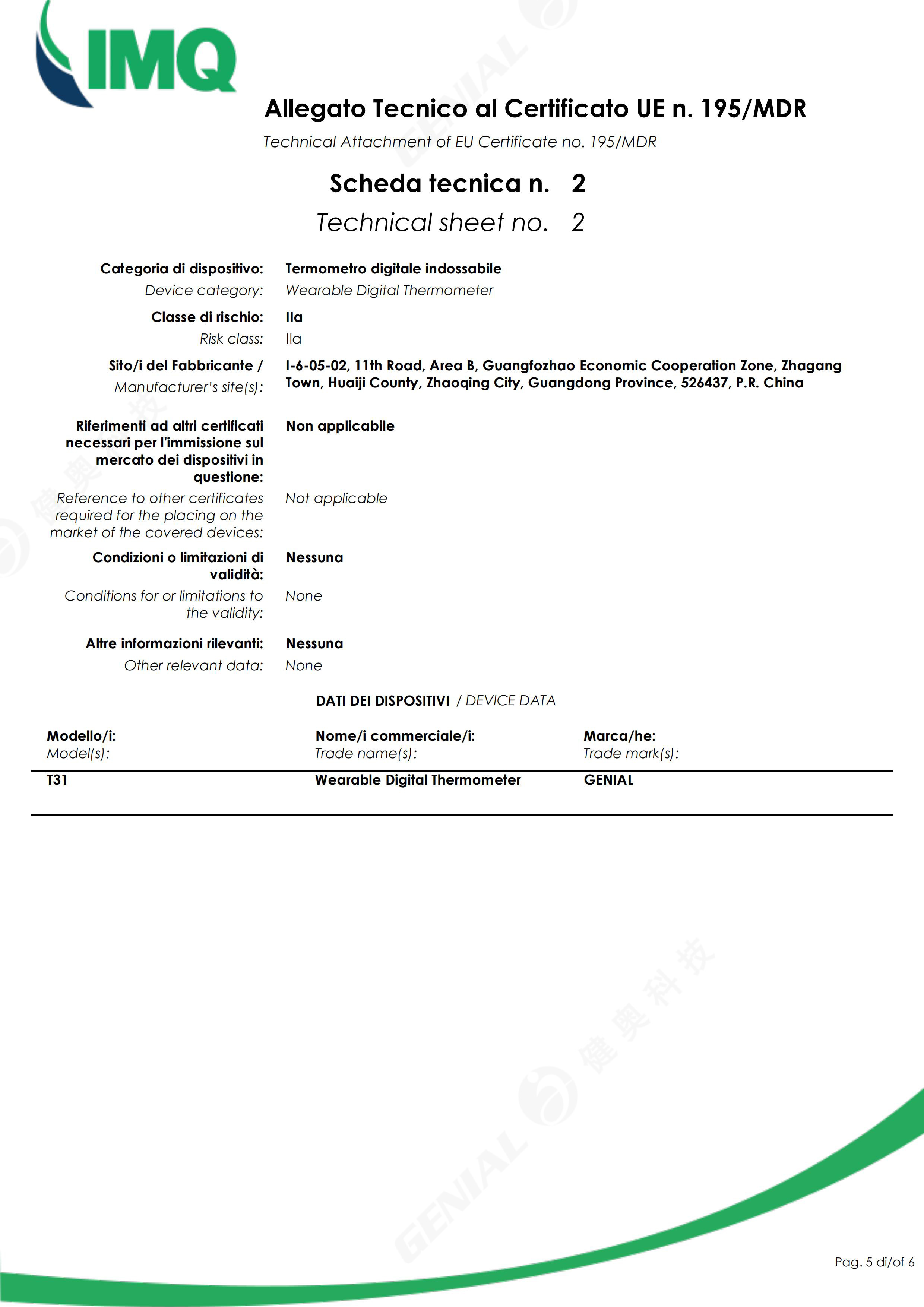
Certificate 195/MDR, issued by IMQ S.p.A (Notified Body No. 0051), is a different instrument: a CE MDR quality management system certificate against MDR (EU) 2017/745, the EN 60601 series and EN ISO 13485:2016, valid from 21 October 2024 to 20 October 2029, covering the T31 wearable thermometer and the full series of fingertip pulse oximeters. One record names product models; the other names a scope of activity for two product families. A buyer sourcing a blood pressure monitor for the EU asks for the first. A buyer sourcing T31 or an oximeter asks for the second plus the product-level technical file.
United States — clearances by product family
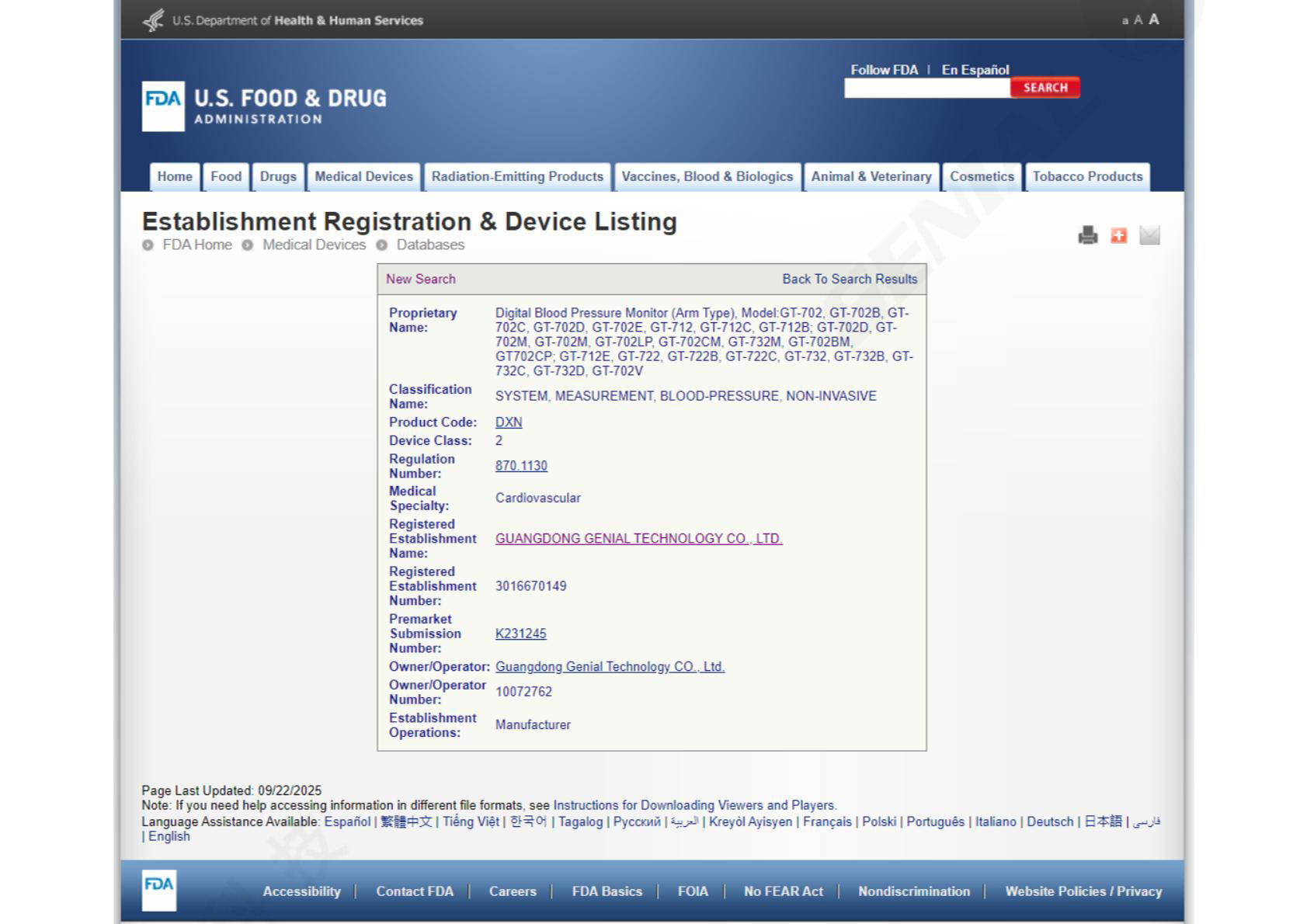
FDA 510(k) premarket notifications held across the portfolio are model-family specific: K210014 covers the T80–T87 infrared forehead thermometers; K231243 covers the GX3–GX14 fingertip pulse oximeters; K231250 covers the GT-701 series wrist blood pressure monitors; K231245 covers arm-type digital blood pressure monitors including GT-702 series, GT-732, GT-732M and GT-702BM; K232678 covers the T23/T24/T25/T26/T28/T28L/T28P continuous-reading digital thermometers; 3016670149 covers clinical electronic thermometers including T11, T12, T19C and T19D; K240333 covers the T31 wearable digital thermometer. A clearance for one family is not a clearance for a neighbouring family with a similar housing.
Japan, Great Britain, Brazil and Russia
Japan: Certificate of Foreign Medical Device Manufacturer BG10501496, issued under Article 23-2-4 of the PMD Act by MHLW, valid 19 November 2024 to 18 November 2029, scope covering the electronic upper arm blood pressure monitor, infrared clinical thermometer, reusable wireless thermometer and pulse oximeter as Class II home-use medical devices.
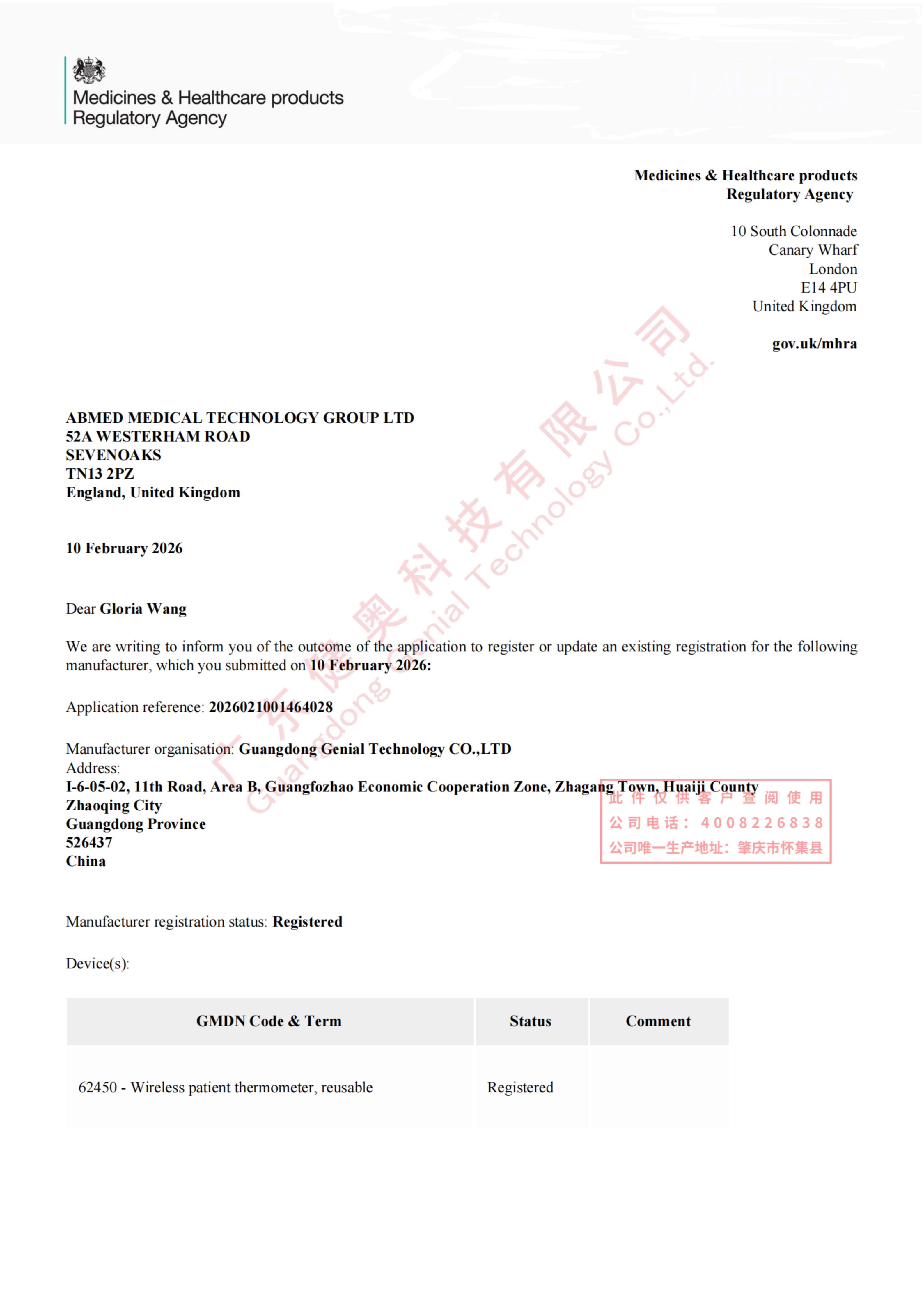
Great Britain: MHRA registration 0000037417, valid from 10 February 2026, scope covering the wireless reusable patient thermometer, pulse oximeter probe, infrared ear/skin thermometer, intermittent electronic thermometer, automatic electronic sphygmomanometer and self-care monitoring software. The GH-series ventilator models are also listed among the related products on that record.
Brazil: ANVISA registration under RDC 751/2022 for Class II medical devices, with a scope naming thermometers, blood pressure monitors and pulse oximeters. Russia: Roszdravnadzor entry No. 1241/1-3 140/2-25 under GOST R national medical device safety and performance standards, issued 12 January 2026, for automatic electronic blood pressure monitors (Marina series).
System and social records that support, but do not replace, product approval
ISO 13485 certificate CN13/31126, issued by SGS United Kingdom Ltd, covers the design, development and manufacture of mesh nebulizers, finger clip pulse oximeters, digital blood pressure monitors, infrared forehead thermometers, infrared ear thermometers and digital body thermometers, valid 16 September 2025 to 16 September 2028. ISO 14001 (02821E10125R1M) and ISO 45001 (02821S10111R1M) are valid 5 March 2024 to 14 March 2027. The amfori BSCI audit, Monitoring ID 25-0372553 and amfori ID 156-037830-000, audited by Intertek, carries an overall rating B and runs 6 February 2026 to 6 February 2028. NBCUniversal manufacturer code L-4394 runs 9 March 2026 to 6 February 2027. GB/T29490 certificate 18123IP0672R2M covers intellectual property management for 9 December 2024 to 14 December 2026.
Note the wording of the ISO 13485 scope. It names six product categories. It does not name the ventilator family or the hair removal device. That is not a defect in the certificate; it is a reminder that a quality system scope statement should be read as written. Where your target category is not named, ask for the applicable system documentation rather than extending the certificate’s language to cover it.
Mapping the documentation set, category by category
Digital thermometers: rigid tip, flexible tip and the accuracy window
Digital thermometers are the category where a label error is easiest to make and hardest to defend. The T11/T12 rigid tip thermometer is specified at 32.0–42.9°C with ±0.1°C accuracy, IPX5, PP housing and 10 g weight, and is catalogued for daily commodity and unbranded export trade. The T19C/T19D adds a fever alert at 37.5°C. The T28 flexible tip thermometer is specified at 32.00–42.90°C with ±0.1–±0.3°C accuracy depending on the temperature range, and its IPX5 rating applies to the probe only — the main body is not waterproof.
Those two T28 details are exactly where declarations go wrong. Quoting “±0.1°C” without the range band, or quoting “IPX5” without “probe only”, produces a declaration that the technical file does not support. Write the full qualified value into the label and instruction text, not the short version.
Infrared digital thermometers: the measurement window is part of the claim
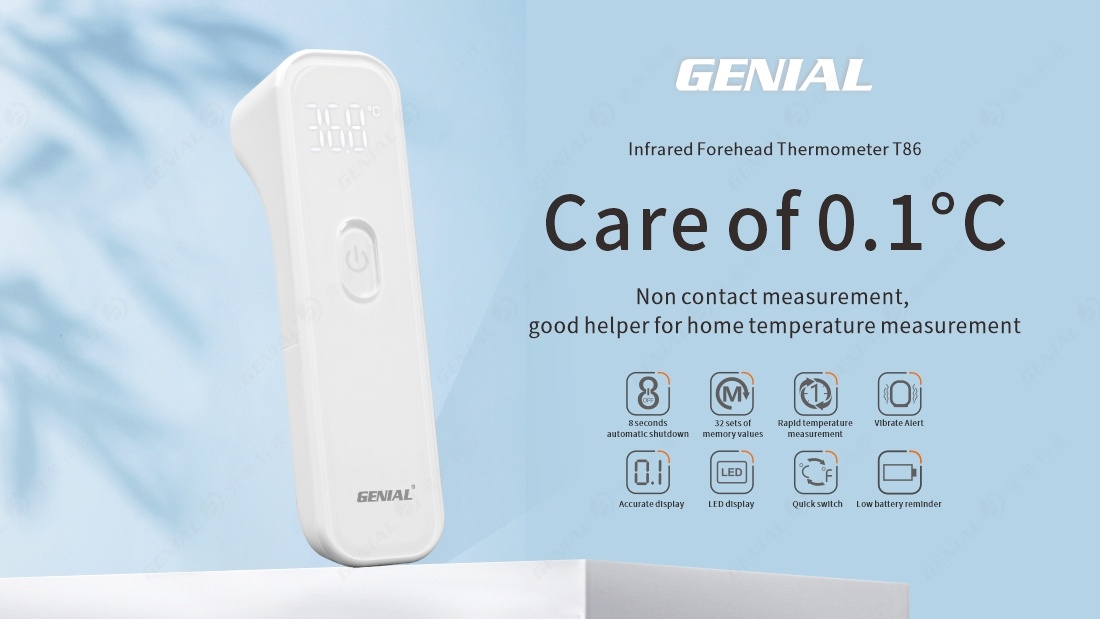
The T86/T87 non-contact infrared forehead thermometer measures 32.0–42.9°C, but the ±0.2°C error figure applies at 35–42°C. It is IPX4, measures 136×36×36 mm at 85 g with battery, and uses an ABS housing with a PC infrared lens. Its catalogue applications include school daily checks, factory epidemic prevention, hospital use and customs entry inspection — four different operating contexts that sit behind one accuracy figure.
If the target market asks for a screening claim at a transport hub or a factory gate, the declaration has to reflect the 35–42°C window, because outside that band the stated error does not apply. For the US market, models T80 to T87 are covered by 510(k) K210014; for Japan, the infrared clinical thermometer sits inside registration BG10501496; for Great Britain it falls under MHRA 0000037417 as an infrared ear/skin thermometer.
Wearable digital thermometer T31: when the software is part of the device
T31 is a wearable Bluetooth digital thermometer designed for 24-hour continuous temperature monitoring, with automatic synchronisation to a mobile app and to the Genial Cloud Platform, abnormal-temperature alerts and remote monitoring for infant fever, chronic disease and elderly care scenarios. It carries FDA 510(k) K240333 and sits inside CE MDR quality management system certificate 195/MDR, and the Japanese registration covers the reusable wireless thermometer category.
This is the clearest category where the documentation set grows beyond the hardware. A continuous-monitoring claim, an alarm function, a cloud record and a mobile application all become part of what the device asserts, and every market that regulates software as part of a medical device will ask about them. The practical question to put in writing is not “is T31 certified” but “which functions of T31 are inside the declared scope for our market” — measurement, data transmission, alerting and record retention are separate answers.
Finger pulse oximeter: a narrow product with a wide market list
The GX3/GX5/GX7/GX8/GX12/GX13/GX14 finger pulse oximeters measure blood oxygen saturation across 35%–100% and pulse rate across 30–250 bpm, using photoelectric transmission measurement with a one-button operation and OLED display. Documentation is unusually complete for a device of this size: FDA 510(k) K231243, the IMQ CE MDR quality management system certificate 195/MDR, ANVISA registration for pulse oximeters under RDC 751/2022, MHRA registration 0000037417 for the pulse oximeter probe, and Japanese registration BG10501496 for the pulse oximeter as a Class II home-use device.
Because the market list is long, the RFQ should be long as well. Ask which of those records applies to the specific model string you are ordering, and ask for the declared SpO₂ and pulse accuracy figures from that model’s technical file. A saturation range of 35%–100% is a measuring range, not an accuracy statement.
Digital blood pressure monitors: cuff range, model string and the GT-732 question
The upper arm blood pressure monitor range shows why model-level mapping matters. Documented pressure measuring range across the models in the specification set is 0–290 mmHg. Arm circumference differs by model: GT-712 and GT-702 are specified at 22–32 cm; GT-702MA, GT-702VA and GT-702BM at 22–42 cm. GT-702BM is further specified with 99 memory sets for two users and an ABS body with a composite fabric cuff. The wrist blood pressure monitor GT-701 is specified at 13.5–21.5 cm wrist circumference with 60 memory groups and ABS housing.
Now the harder case. GT-732 and GT-732M appear in the CE certificate CN25/00007953 model list and in FDA 510(k) K231245, and they appear in the Japanese, Brazilian and Russian records as related models. What a scope entry does not do is publish a specification. If your declaration needs the housing material and arm circumference for GT-732, or the pressure range and pulse error for GT-732M, those values must be confirmed against that model’s own datasheet and technical file. Lifting GT-702BM’s 22–42 cm cuff range or the 0–290 mmHg figure across to GT-732M and printing it on a label is not a shortcut; it is a fabricated specification, and it will fail an audit or a customs check even though each individual number is real for a different model.
The same discipline applies to the cuff you actually ship. If a market declaration states 22–42 cm and the carton contains the 22–32 cm version, the certificate is intact and the product is still wrong for that label.
Mesh nebulizer: category naming inside a quality system scope
The mesh nebulizer range — N11/N21 and N12/N22/N12C/N22C/N12L/N22L — uses 106 kHz ultrasonic mesh atomisation with a particle size of ≤5 µm and an atomisation rate of ≥0.50 ml/min, which is the technical basis for the claim that medication reaches the lower respiratory tract more effectively than with coarse nebulisation. The mesh nebulizer category is named explicitly in the ISO 13485 certificate scope CN13/31126, which is a useful starting point because it means the design, development and manufacture of that category sit inside the certified system.
It is not the end point. The documented requirement set for nebulizers names NMPA medical device registration for the domestic market and RoHS / IECEE CB certification for export. Those are requirements to be confirmed per model and per market, and a buyer should ask which of them are actually held rather than assuming the requirement list is a holding list.
Sleep apnea therapy device and ventilator: check whether the category is named
The GH-series sleep apnea therapy device operates in CPAP/APAP mode with a pressure range of 4–25 cmH₂O, a fan system rated at ≤35 dB, AC 100–240 V input and optional heated humidification, with S/T/VGPS modes and an optional built-in lithium battery. These are therapy devices rather than monitoring devices, and therapy claims carry heavier documentation in every market.
The MHRA record 0000037417 lists the GH-series ventilator models among its related products, which is a strong signal for the Great Britain market. The ISO 13485 scope text, by contrast, does not name the ventilator category. That combination is precisely why the question has to be asked in writing: “which record, by number and scope, covers model GH-B25V in our target market, and what is the intended-use wording on that record?” A related-product listing and a scope entry are not interchangeable answers.
Hair removal device: a personal-care device with a different claim boundary
The GI02/GI06 hair removal device uses 560–1200 nm IPL intense pulsed light with sapphire cooling, rechargeable lithium battery power, skin-contact flash recognition and adjustable energy levels, and is documented with an NMPA medical device registration under Guangdong Registration Standard No. 20252090497, plus sapphire cooling anti-burn technology and OEM appearance customisation.
This is the category in the portfolio where the claim boundary is most often blurred. A China NMPA registration is a starting point for the China market. It does not by itself establish European or United States market access, and it does not convert a personal-care device into a home monitoring device. The intended-use sentence, the recommended user group (healthy adults aged 18 and above in the documented application profile) and the operating environment all belong in the declaration, and each target market has to be asked about separately.
Five intended-use statements and what each one changes
- Community clinic. A clinic setting implies an operator, which usually pulls the device toward professional-use wording. The GT-712 and GT-702MA are catalogued against community clinic, physical examination centre and elderly-care channels, but the channel tag is a commercial label. Confirm whether the certificate scope supports a professional-use statement before printing one.
- Chronic disease management. Repeated measurement over time brings memory functions into the claim. GT-702BM’s 99 memory sets for two users and GT-702MA’s WHO blood pressure classification function are the kind of features a chronic-care programme will rely on, so they must appear consistently in the label, the instruction manual and the app.
- Home monitoring. Self-measurement without supervision is the classic home-use claim. The GT-701 wrist monitor (13.5–21.5 cm wrist, 60 memory groups) and the GT-702 upper arm monitor (22–32 cm) sit here, and the cuff range printed on the box is the single most common source of returns.
- Wholesale distribution. A mixed-SKU container needs each SKU checked separately. GT-702BM is catalogued for medical instrument wholesale and offline household retail; that tells you the channel, not that every carton in the container shares one certificate.
- OEM gift channels. GT-702VA is catalogued for global export trade and the complimentary gift industry; GT-701 for daily necessities and low-cost promotional gift; T11/T12 for daily commodity and unbranded export trade. A gift SKU still carries a medical device label if the product is a medical device. Under OEM, packaging, gift box, user manual, logo printing and colour schemes are customisable while core hardware, PCB and key functions stay unchanged — which means the technical claim travels with the model, and the gift channel changes the box, not the evidence.
Step by step: raising compliance questions before order acceptance
- Write the intended-use sentence first, in one line. Who measures, what is measured, where, and under whose supervision. Do this before comparing models, because the sentence eliminates half the range immediately.
- Fix the exact model string. GT-702, GT-702B, GT-702C, GT-702D, GT-702E, GT-702M, GT-702L, GT-702V, GT-702VA, GT-702MA, GT-702LM, GT-702CM, GT-702BM, GT-702CD, GT-712, GT-712B, GT-712C, GT-712E, GT-732, GT-732B, GT-732C, GT-732D, GT-732M and GT-703M are separate identities. A purchase order that says “GT-702 series” cannot be matched to a certificate list.
- Match the string to a scope, not to a brand. Check the certificate or clearance number, the issuing body, the scope text and the validity dates. A scope that names a category is not the same as a scope that names your model.
- Identify the instrument type. Product certificate, quality management system certificate, foreign manufacturer registration and social-compliance audit answer different questions. BSCI does not approve a device; ISO 13485 does not approve a device; both support a file that still needs a product-level approval for the market.
- Check the dates while you check the scope. CN25/00007953 runs to 25 November 2030; BG10501496 to 18 November 2029; 195/MDR to 20 October 2029; CN13/31126 to 16 September 2028; BSCI to 6 February 2028; GB/T29490 to 14 December 2026. A valid certificate today can still be expired at the end of a two-year distribution agreement, so put the renewal question in the contract discussion.
- Match every declared value to the datasheet. Cuff range, accuracy band, pressure range, IP rating, weight, materials. The T28 probe-only IPX5 rating and the T86/T87 35–42°C accuracy window are standard examples of qualifiers that must survive into the label.
- Separate the packaging change from the technical change. OEM covers packaging, gift box, manual, logo and colour. ODM covers industrial design, tooling, structure, PCB firmware, algorithms, Bluetooth functions, display interface, packaging system and exclusive model registration. The second list changes what has to be re-declared; the first list does not.
- Record the answer in the order. Put the certificate number, the covered model, the market and the intended-use sentence into the purchase documentation. If a question cannot be answered in writing before acceptance, it will not be answerable after shipment.

Category comparison: what has to match the declaration
| Product category | Documented models | Records named in this guide | Specification that must match the label |
|---|---|---|---|
| Infrared digital thermometer | T86/T87 (forehead, non-contact) | FDA K210014; CE MDR CN25/00007953; Japan BG10501496; MHRA 0000037417 | ±0.2°C applies at 35–42°C; IPX4; 32.0–42.9°C range |
| Digital thermometer, rigid tip | T11/T12, T19C/T19D | FDA 3016670149; ANVISA RDC 751/2022; CE MDR CN25/00007953 | ±0.1°C; IPX5; fever alert at 37.5°C on T19C/T19D |
| Digital thermometer, flexible tip | T28 | FDA K232678; CE MDR CN25/00007953 | ±0.1–±0.3°C by temperature band; IPX5 probe only |
| Wearable Bluetooth thermometer | T31 | FDA K240333; CE MDR QMS 195/MDR; Japan BG10501496; MHRA 0000037417 | Continuous-monitoring claim plus app, cloud and alert functions |
| Finger pulse oximeter | GX3–GX14 | FDA K231243; CE MDR QMS 195/MDR; ANVISA; MHRA; Japan BG10501496 | SpO₂ 35%–100%; pulse 30–250 bpm; declared accuracy from the technical file |
| Wrist blood pressure monitor | GT-701 series | FDA K231250; CE MDR CN25/00007953; ANVISA; Russia No. 1241/1-3 140/2-25 | Pressure 0–290 mmHg; wrist circumference 13.5–21.5 cm; 60 memory groups |
| Upper arm blood pressure monitor | GT-702, GT-712, GT-702MA, GT-702VA, GT-702BM, GT-732, GT-732M | CE MDR CN25/00007953; FDA K231245; Japan BG10501496; Russia; ANVISA | Cuff range per model: 22–32 cm or 22–42 cm; GT-732/GT-732M values from their own datasheets |
| Mesh nebulizer | N11/N21, N12/N22/N12C/N22C/N12L/N22L | ISO 13485 CN13/31126 (category named); NMPA and RoHS / IECEE CB named as requirements | Particle size ≤5 µm; atomisation rate ≥0.50 ml/min; 106 kHz mesh technology |
| Sleep apnea therapy device | GH-B20V/GH-B25V/GH-B20T/GH-B20/GH-B25/GH-A20A/GH-A20 | MHRA 0000037417 (related products); ISO 13485 scope does not name the category | Pressure 4–25 cmH₂O; ≤35 dB; AC 100–240 V |
| Hair removal device | GI02/GI06 | NMPA registration, Guangdong Registration Standard No. 20252090497 | 560–1200 nm IPL; sapphire cooling; intended user group and operating environment |
Frequently asked questions
Does a CE certificate that lists GT-732 also cover every other upper-arm model in the range?
No. Certificate CN25/00007953 from SGS Belgium NV (Notified Body No. 1639), issued under MDR (EU) 2017/745 Annex IX Chapter I & III, lists arm-type blood pressure monitor models by number, including GT-702, GT-702B, GT-702C, GT-702D, GT-702E, GT-712, GT-712B, GT-712C, GT-712E, GT-722, GT-722B, GT-722C, GT-732, GT-732B, GT-732C, GT-732D, GT-702V, GT-702M, GT-702L, GT-702BM and GT-732M, and is valid from 25 November 2025 to 25 November 2030. A model that is not on that list is not covered by that certificate, even if the housing looks the same. Match the model string character by character before the label is printed.
Is an ISO 13485 certificate the same as a product approval?
No, and the two are often confused. ISO 13485 certificate CN13/31126 from SGS United Kingdom Ltd covers the design, development and manufacture of mesh nebulizers, finger clip pulse oximeters, digital blood pressure monitors, infrared forehead thermometers, infrared ear thermometers and digital body thermometers, valid 16 September 2025 to 16 September 2028. It certifies a management system for those activities. CE MDR quality management system certificate 195/MDR from IMQ S.p.A (Notified Body No. 0051), valid 21 October 2024 to 20 October 2029, covers the T31 wearable thermometer and the fingertip pulse oximeter series. Neither document replaces the product-level approval for the market you are entering, and neither should be quoted as if it did.
How should an OEM gift order be handled differently from a retail order?
Legally, very little changes; commercially, the box changes. GT-702VA is catalogued for global export trade and the complimentary gift industry at 22–42 cm arm circumference and 0–290 mmHg; GT-701 is catalogued for daily necessities and low-cost promotional gift with a 13.5–21.5 cm wrist range; T11/T12 is catalogued for daily commodity and unbranded export trade. Under OEM, packaging, gift box, user manual, product logo printing, colour schemes and packaging specifications are customisable, while core hardware, PCB and key functions remain unchanged. That means the technical claim set travels with the model into the gift channel. Keep the label and instruction language aligned with the certificate scope and with the target market’s language requirement, and treat a gift SKU as a medical device if the product is one. Relevant OEM minimums are 10,000 pieces for thermometers and 2,000 units for oximeters, infrared thermometers, blood pressure monitors, nebulizers and wireless thermometers, with ventilators at 500 units.
What sample, MOQ and lead-time terms apply before we commit?
OEM terms are: samples in 3 days, small orders in 3–7 days, mass orders in 10–15 days. ODM terms are: minor modifications without new tooling in 7–15 days at a 5,000-unit minimum; new mould development in 45–50 days at a 10,000-unit minimum, with tooling cost refundable on large-volume projects. JDM starts at an initial mass-production order of 10,000 units with a 45–60 day lead time. OBM stock ships within 48 hours, replenishment orders take 5–7 days, and mixed orders can start from 5 cartons against a full-carton minimum per SKU. Every mode carries a free 12-month warranty against valid proof of purchase. These terms belong in the same document as the compliance scope, because a lead time that assumes a model already in the certificate is very different from one that assumes a new registration.
What should a documentation request contain before we accept an order?
Five items, in this order: the exact model string as it will appear on the label; the target market and the one-line intended-use sentence; the certificate or clearance number, issuing body, scope text and validity dates; the datasheet values that will appear in the declaration, such as cuff range, accuracy band, pressure range and IP rating; and the name of whoever holds the registration in that market. Compare the scope text against the model string character by character, and keep the written answer in the purchase file. If you are building that request now, the GENIAL team can supply the documentation pack for the specific models and markets in your programme through Guangdong Genial Technology Co., Ltd, and the 2026 English catalogue is available for download as a PDF brochure for range planning.
Conclusion: the scope text is the answer, not the logo
Regional compliance for home medical health devices is not a single certificate that a supplier either has or does not have. It is a mapping exercise: intended-use sentence, then exact model string, then the specific record for that market, then the datasheet value that will appear on the label. The seven categories in this guide behave differently inside that exercise. A digital thermometer turns on an accuracy band and an IP qualifier; a wearable thermometer turns on its software functions; a blood pressure monitor turns on the cuff range for the exact model; a mesh nebulizer turns on whether its category is named in the quality system scope; a ventilator turns on a question that a related-product listing does not fully answer.
The practical outcome is simpler than the detail. Ask for the certificate number, the scope text and the dates before the order is accepted, and write the intended-use sentence into the order file. When a value is missing for GT-732, GT-732M or any other specific model, request it against that model’s own datasheet rather than borrowing it from a sibling. That single habit prevents most of the label, customs and audit problems that surface months after shipment.
Have Questions or Need More Details?
Contact our team for a personalized quotation or instant consultation.
Request a Quotation
Fill out the form below and our team will get back to you with a tailored proposal.
WhatsApp Direct Chat
Prefer to chat in real-time? Message us on WhatsApp for instant assistance & quick answers.
- Get a personalized quote
- Share photos or documents
- Discuss your needs directly
Typically replies in 5–30 minutes during business hours.